Saturday, September 09, 2006

Smokin' in the Boys' Room

A Nashua, N.H., man faces a felony reckless conduct charge for shooting at the ceiling of a Wal-Mart men's room, police say...

Asked why he was carrying a concealed weapon, he reportedly told officers, "Well, I have the right to bear arms, you know."
Thanks, moron. You're just the kind of spokesman we so desperately need.

That aside, how many "Only Ones" involved in negligent discharges have felony raps hanging over their heads?

We're the Only Ones Dancin' to the Jailhouse Glock Enough

Investigators are trying to figure out how a loaded handgun go [sic] into a cellblock inside D.C. Superior Court.

Oh, gee, I wonder.

I mean, The Only Ones were in charge, and it's not like this has ever happened before.

Money for Nothing

Donations poured into the Kent County gun buyback program Friday, just one day after the program doled out all the $50 vouchers it had.

Two organizations came forward on Friday afternoon with more cash and incentive. Saint Mary's Hospital and Steelcase each kicked in $2500.

Don't you just love the name of "The Only One" quoted in this propaganda release: Roger Parent...?

We're the Only Ones Rangy and Guarded Enough

A Harnett County sheriff’s deputy earlier this week left an unloaded shotgun at a shooting range behind a state prison...

On Thursday morning, a group of inmates was cleaning the shooting range and someone found the shotgun on a picnic table, Rollins said. The shotgun was returned to the Sheriff’s Office.

The sheriff said it was his understanding that an inmate found the gun. But a spokesman at the prison said an inmate did not find it. He would not comment further and referred questions to the Sheriff’s Office.
If it was an inmate who handed it over, do you suppose they'll prosecute him for being a felon in possession of a firearm?

Leaving guns laying around for prisoners to find...you can't make this stuff up.

[More from "The Only Ones" files...]

Dueling Amendments

The state's highest court ruled Friday that the University of Utah has no right to ban guns on campus, rejecting the argument that prohibiting firearms is part of the school's power to control academic affairs...

But no one will be permitted to carry a gun anytime soon on the campus, home to more than 44,000 students, faculty and staff members. Friday's ruling resolved only the state issues involved in the matter; the case now goes back to U.S. District Court in Salt Lake City for litigation of federal constitutional issues.

The delay is welcome to Landon Smith and Minna Shim, U. students who say they support the ban, which has been in place for almost three decades.

"It scares the hell out of me," said Smith, a senior in communication. "I don't want some cowboy coming to class with a gun."

Shim, an undeclared freshman, said, "I don't feel a threat here now, but if there are concealed weapons around, I'd be afraid."

U. President Michael Young said he was disappointed by the decision.

"Universities across the country uniformly prohibit guns on campus," he said. "We hope that, following a review of this case in federal court, the issue will be resolved to uphold our long-standing policy of keeping firearms off campus."

The U. is arguing that any interference with its gun policy violates its right to academic freedom guaranteed by the First and 14th amendments.

I'm sorry, Landon and Minna, that your bigotry and enuresis aren't deemed sufficient justification to define the rights of free sovereign individuals who aren't pathetic, ignorant and immature.

I also love how "authorized journalists" Pamela Manson and Sheena McFarland somehow couldn't investigate deep enough into the subject to find some reasons why carrying a gun on campus might not be such a bad idea. I'm sure it's because no victimization ever occurs there...

But the real danger of this story isn't with the snivelers--it's with the legal approach employed by the university: Dueling amendments. We are truly living in the Bizarro world when the First and Fourteenth are seriously proposed as counterweights to the Second.

To say the least, it will be interesting to see what the District Court does with this.

Update: Stan shares his thoughts.

This Day in History: September 9

The Second Continental Congress changed the name of the nation to the United States of America, from the United Colonies.

Friday, September 08, 2006

Can Gun Control Reduce Violence?

[Yesterday, I posted a quote from Preston K. Covey, Ph.D. Professor Covey has graciously authorized WarOnGuns to post his entire presentation, to use his words, "in the spirit of 'pass the ammunition'."

This currently appears nowhere else on the Internet, and I am grateful to Professor Covey for allowing me to present it here. How rarely do we see an academic speaking plainly to legislators about the folly of "gun control"? This is good stuff--much of which even an ornery absolutist like me can agree with--and deserves to be disseminated far and wide. I hope you will agree and help to do so by sharing the url to this post. This is one smart man, and his perspectives make us think.--DC]


Can Gun Control Reduce Violence?

What Do We Know? What Do We Need to Know?
Commonsense Logic & Ethics for Evaluating Policy Options

Cases in Point: Restricted Purchases & Permissive Carry Laws

presented to

The Pennsylvania Senate Judiciary Committee Hearing on Urban Violence

August 10, 2006
Pittsburgh, PA

by
Preston K. Covey, Ph.D.
Director, Ethics, History, & Public Policy Program
Department of Philosophy
Carnegie Mellon University

Preston received his B.A. (Psychology) and Ph.D. (dual, in Philosophy and in the Humanities Graduate Program)from Stanford University, and is a tenured Associate Professor of Philosophy, Founding Director of the Center for the Advancement of Applied Ethics, and Director of the inter-departmental Ethics, History, & Public Policy Program at Carnegie Mellon University, where he teaches courses in ethics, law, public policy, and conflict resolution as well as issues of criminal justice and violence in American society.

Preston served for a decade as a fully sworn Special Deputy Sheriff detailed to the Firearms Training Staff of the Sheriff’s Reserve of Allegheny County PA, on the Board of Directors of the National Institute of [Law Enforcement] Ethics, and currently serves as a deadly-force and officer-survival training consultant for Team One Network, a national consortium of law enforcement firearms and use-of-force trainers (www.teamonenetwork.com).

He is a member of the American Society of Criminology, the Academy of Criminal Justice Sciences, the Institute of Criminal Justice Ethics, the Society for Risk Analysis, the Risk Assessment & Policy Association, the Association for Conflict Resolution, the International Wound Ballistics Association, and the Institute for Research on Small Arms in International Security.

Preston served on the Ethics Committee of the American Society of Law Enforcement Trainers (ASLET) from 1994-2000 and has served on the following committees of the International Association of Law Enforcement Firearms Instructors (IALEFI): Firearms Training Standards Committee, Instructor Criteria Committee, Safety Committee, and Ethics Committee. He has been a member of ASLET and IALEFI since 1990 and 1991, respectively.

In 1994, Preston was elected by the IALEFI Board of Directors to Life Member (a service award, the fourth in the history of IALEFI) for outstanding service to law enforcement firearms and lethal force training.

He is Editor and co-principal author of IALEFI's Standards and Practices Reference Guide for Law Enforcement Firearms Instructors and (with 600 hours of certified training himself) served for over a decade as an instructor in lethal threat management and the judicious use of deadly force by police officers and civilians.

Recent publications and research projects include a book entitled Gun Control: For & Against (invited by Rowman & Littlefield), the articles on Gun Control in The Encyclopedia of Applied Ethics (Academic Press, 1997) and The Encyclopedia of Ethical Issues in Politics & Media (Academic Press, 2000), and the articles on Self-Defense--Legal Issues, Self-Defense—Reasons for Gun Use, and The ‘Sporting Purposes’ Test (an analysis and principled critique of the 1994 federal ‘assault weapon’ ban) in Guns in American Society: An Encyclopedia of History, Politics, Culture, and the Law, Gregg Lee Carter, Editor (ABC-CLIO, 2002).

Introduction

Mr. Chairman and members of the committee, I thank you for the opportunity to address this panel.

I hope to provide perspective for your important public service on the evaluation of policy options addressing urban violence.

Guns figure prominently in urban violence, so gun control is high profile.

But there are ‘101’ types of interesting gun control. (I provide a typology --and the controversies attending them-- in my article on Gun Control in The Encyclopedia of Ethical Issues in Politics & the Media Academic Press, 2000.)

Briefly today, I focus on just two types: RESTRICTIVE and PERMISSIVE

and relevant examples of each type: RESTRICTIVE PURCHASE LAWS
and PERMISSIVE CARRY LAWS


To set the stage: Three Keynotes

It ain’t what we don’t know that’s the problem. It’s what we know that ain’t so.
-- a paraphrase of Josh Billings/Mark Twain/Will Rogers/Artemus Ward [origin disputed]

It’s easy to lie with statistics, but easier to lie without them.
-- Frederick Mosteller
(Founder of Harvard’s Statistics Department & premier pioneer of applied stats in public affairs)

The great enemy of the truth is very often not the lie -- deliberate, contrived, and dishonest -- but the myth -- persistent, persuasive, and unrealistic.
-- President John F. Kennedy

What we don’t know is indeed a big problem.

But what we think we know that ain’t so corrupts public inquiry into what more we need to know.

My students complain that statistics can be used to “prove” anything you want.

They learn to be more discerning -- to discern that among contrary research findings some are damn well better than others.

First, fair warning about where I’m coming from:

Commonsense Logic & Ethics for Evaluating Policy Options

Commonsense is a commodity that’s commonly available, but not often enough availed.

Guns in our society are commonly available.

Violence --criminal violence-- is too often availed.

It seems commonsense to think that the incidence of violence correlates with the availability of guns and would be reduced by restricting gun availability.

At your committee’s Philadelphia hearing, Police Commissioner Johnson proclaimed [quote]:

“I think the availability of guns is the real problem.”

Commonsense --more strenuously deployed-- shows us that it’s not that simple.

For starters, it depends on what we mean by “availability.” This is not some silly semantic gamesmanship like Clinton’s “Well, it depends on how you define ‘sex’.”

Pennsylvania has more guns & more carry licensees per capita than any other state. Yet – if Philadelphia is subtracted from the equation— our state’s homicide rate is as low as Western Europe’s and our violent crime rate is lower than England’s.

Quantity of guns and quantity of violence are NOT simply or uniformly correlated.
----------
My Value, Fact, & Policy seminar at Carnegie Mellon frames the commonsense logic of how facts and values are inter-related in the evaluation of policy and the commonsense ethics of debating policy options.

Sub-titled Violence in America, the seminar addresses inter-related issues of crime control, drug control, & gun control. Our basic interest is in questions like:

“Is this a good policy?” “What do we need to know to decide or judge?”
and –equally important-- “How should we vote when we don’t know?”

Logic tells us that we can’t answer the question “Is this a good policy?” without answering the logically prior question “GOOD FOR WHAT PURPOSE?”

Ethics tells us that in honest controversy our duty is to hark to the best evidence available --the best research delivered by the best methods and the best authorities.

I’ll illustrate these imperatives with policies of interest to the committee:

RESTRICTIVE GUN PURCHASE LAWS

The bad news is that there’s enough equivocal research out there to confuse the unwary, such that we often can’t know “beyond a reasonable doubt” the very best options --or best combination of options-- for reducing violence, even gun violence.

The good news is that there’s enough unequivocal evidence to keep debate honest and to distinguish good firearms policy from bad in a lot of cases -- by a “preponderance of the evidence” if not, indeed, “beyond a reasonable doubt.”

Let’s take a couple examples of restrictive purchase laws for illustration:
----------
The 1994 Ban on So-Called ‘Assault Weapons’ & High-Capacity Magazines

Was this a good policy? That depends on the purpose for which it’s evaluated.

Logic says that the purpose for which anything is evaluated dictates the criteria by which it must be evaluated --and the kind of evidence needed to evaluate whether it achieves a given goal.

The ban was good for inciting pre-ban purchase & hording of banned items
--an unintended pre-ban effect

It was good for skyrocketing the price to lawful buyers of pre-ban items
--a collateral cost (intended or not) to law-biding citizens

It was good for making advocates & believers feel good when it passed
--a partisan benefit irrelevant to the common good

It might have been good for softening-up middle-roaders for further bans
--an ulterior purpose of some gun-ban advocates:

As Charles Krauthammer frankly wrote in The Washington Post (4/5/06):
"Passing a law like the assault weapon ban is a symbolic - purely symbolic - move . . . Its only real justification is not to reduce crime but to desensitize the public to the regulation of weapons in preparation for their ultimate confiscation. . . The real steps, like the banning of handguns, will never occur unless this one is taken first."
But was it good for its vaunted pretext, for the purpose of reducing violence

--in particular, reducing the quantity of harm from gun violence?

The good news on this critical question is that we have state-of-the-art mandated-by-law government-sponsored research on the ban’s effects; for example:

The National Research Council 2005 report Firearms & Violence: A Critical Survey, available from the National Academies Press, Chapter 4 Interventions Aimed at Illegal Firearm Acquisition, pp.96-97, citing C.S. Kopper & J. Roth. 2001: The impact of the 1994 federal assault weapon ban on gun
violence outcomes .... Journal of Quantitative Criminology Volume 17, Issue 1 and
The impact of the 1994 federal assault weapon ban on gun markets .... Journal ofQuantitative Criminology Volume 18, Issue 3.

The bad news is that the answer --on the best available evidence-- is NO, the ‘assault weapon’ ban had no discernible effect respecting its ultimate goal: reducing criminal violence --even criminal gun violence.

More specifically, it had no effect on the crucial OUTCOMES OF INTEREST
--the very rationale for banning so-called ‘assault weapons’—to wit:

THE QUANTITY OF HARM from criminal gun violence --in particular, THE RATE OF MULTIPLE-WOUND & MULTIPLE-VICTIM SHOOTINGS.

There are many interesting tactical reasons for this, but three major factors are:

(1) that the ban’s long-gun targets figured in only a small fraction of criminal violence in the first place,
(2) SUBSTITUTION of non-banned repeating firearms which provide comparably lethal firepower for all criminal purposes, and
(3) residual availability because of the vast quantity of banned items already in lawful and illicit circulation.

The research cited also doubts that the ban had any effect in its proximate goal of reducing the availability of the banned items to criminals. But the ban’s effect on criminal markets is academic and beside the point, insofar as the ban had no discernible manifest effect on the quantity of harm from criminal violence.

On the other hand, the ban imposed blanket restrictions and appreciable costs on law-biding citizens for ten years.

Basic ethics says that the benefits of any policy for the common good must outweigh –or counter-balance-- the costs or harms to innocent law-biding folk.

Restrictions on the liberty of the law-abiding require counter-balancing benefit.

But the ‘assault weapon’ ban had NO demonstrable benefits to the commonweal. Except, of course, for the lessons learned from this expensive ten-year experiment.

Sure, we can learn by mistakes. But at what cost? And at whose expense?

Some think that the lack of evidence of benefit just shows that the gun ban/the experiment wasn’t restrictive enough, comprehensive enough, or allowed to continue long enough. That’s mere speculation –of the kind that advocated the ban.

OK. But how far are we justified in experimenting --with no evidence, merely on speculation, and at a stiff cost to the vast law-biding populace-- in order to try to control a fractional criminal element? (Counter-terrorism is a separate issue.)

Of course, the burden of justification is less when the cost to the law-biding is less.

Putting aside blunt-instruments and blanket prohibitions on legitimate interests like gun bans, what about more modest, less invasive purchase restrictions that try surgically to target the criminal cancer in the body politic? For example:

Background Checks For the Purchase Of Handguns

Background screening is a prime example of a low-burden purchase restriction. (Today --with instant background checks-- waiting periods are a separate issue.)

Is this a good policy? Good for what?

The Brady law’s proximate goals and effects are to prevent people with criminal records from acquiring handguns from lawful gun shops, to cut off one source for criminal gun acquisition, and –presumably-- thereby raise the cost of guns to criminals.

A policy that raises the cost of guns to criminals is arguably good enough
-- provided that the cost to law-biding buyers is negligible (e.g., a few minutes wait and low risk of a false-positive in the NCIS with resultant false denial or arrest).

The ultimate goal of supply-side restrictions on the law-biding surely should be demonstrably to reduce both criminal gun availability and criminal gun violence. But these outcomes –for point-of-sale background screening alone-- are extremely difficult –if arguably unnecessary-- to demonstrate . . .

. . . because many other illicit sources make guns available to criminals: e.g., theft, robbery, fraudulent retail purchases, finding corrupt licensed gun dealers willing to ignore the law, and ‘straw buyers’ (who buy guns legally to sell illegally to others).

This brings us to a much debated purchase restriction:

The One-Gun-a-Month Limit

Is this a good policy?

When we debate this question (for a city, county, or state):

Logic requires us to identify the policy’s express and tacit, perhaps various PURPOSES for which it is to be evaluated –especially its proximate and ultimate goals respecting the common good (as well as its ulterior partisan motives);
and
Ethics requires us to seek the best available evidence of its actual OUTCOMES respecting its benefits for the common good --as well as its collateral costs or harms to legitimate interests of the vast law-biding, tax-paying public.

There are several candidate goals for one-gun-a-month purchase limits:

A. Political kudos for publicly addressing the problem of gun violence, which is certainly compatible with --although it does not ensure:

B. Cut off one source of criminal gun acquisition (multi-gun proxy buyers), which is certainly compatible with --although it does not ensure:

C. Reduce the embarrassing number of crime guns retrieved in other cities or states that are traced to one’s home city or state as the point of first purchase, which is certainly compatible with --although it does not ensure:

D. Reduce overall gun availability to criminals, which is difficult to demonstrate given all the other criminal sources and criminals’ ingenuity in creating supply where there’s demand

Then there are the ultimate goals of greatest public (as versus political) interest:

E. Reduce criminal gun violence, which might result from D, but neither D nor E follow from achieving the other goals (A, B, or C)

F. Reduce overall criminal violence, certainly the Gold Standard of outcomes:

If reducing criminal gun violence does not reduce overall criminal violence, we need to rethink “What, after all, is the good of the purchase restriction?”

Another crucial question: Which of these several goals –if achieved according to the best available evidence— are necessary or sufficient to justify the policy?

Surely, at the least, reducing criminal GUN violence is a necessary outcome for a GUN control policy.

Some states have implemented one-gun-a-month limits. So there’s available research on this policy’s performance record.

Take Virginia, an instructive example on what we need to know and consider in debating such a policy for any specific jurisdiction –city, county, or the whole state.

The evaluation of outcomes from Virginia’s 1993 one-gun-a-month limit is nicely summarized and referenced in

The National Research Council report Firearms & Violence: A Critical Survey, Chapter 4, Interventions Aimed at Illegal Firearm Acquisition, pp.93-94.

(See also Chapter 9, Criminal Justice Interventions to Reduce Firearm-Related Violence, on collateral policies or alternatives to restricting legal purchases: tough policing of gun dealers as well as the proxy buyers who sell to criminals – more vigorously exploiting under-enforced existing laws.

This kind of intervention strategy has been called Pulling Levers: coordinating federal, state and local resources to pull every available legal lever to target suspicious dealers and multi-gun buyers for investigation, and –if warranted-- vigorously prosecute them, fully enforcing existing law.)

The NRC’s assessment makes a crucial point [quote]:

“. . . in order for this intervention to workin the sense of reducing violence – not only must the intervention make it more difficult for criminals to get new guns but also the substitution possibilities must be limited.

“That is, comparably harmful guns cannot be available from comparably accessible sources.” [All emphases in quoted material are mine.]

One such source is multi-gun proxy buyers in neighboring jurisdictions that do not have a one-gun-a-month limit.

This is the problem of ‘leakage’ from less restrictive states into more restrictive states, and a reason that advocates urge national legislation, to ensure uniform suppression of a crime-gun source like proxy buyers.

Before the 1993 passage of its one-gun-a-month law, Virginia had been one of the leading source states for crime guns recovered in northeastern cities.

The NCR cites research that, using BATF trace data, showed the following:

In the first 18 months after the law was implemented, the quantity of guns recovered in the northeast that were traced to Virginia was greatly reduced, from 35 percent before the law was implemented to 16 percent.

The NCR further notes [quote]:

“This study indicates a change in the origin of traced crime guns following the change in the law.

“. . . the law change had an effect.

“The Virginia legislature may ... have achieved its goal of reducing the role of the state in the interstate illegal gun trade.

However, [the ultimate purpose of the law—reduction in violence] may have been undermined by a substitution of guns first purchased in Virginia to guns first purchased in other states.

An important question not addressed by this study is whether the law change affects the ultimate outcome of interest

--the quantity of criminal harm committed with guns—

or even the intermediate questions of the law’s effects on the number of guns purchased or owned.”

The NRC highlights the crucial question of what we need to know (what research needs to be done) in order to conclude whether a one-gun-a-month limit is a good policy for purposes of

reducing the quantity of harm from overall criminal violence
or at least
reducing the quantity of harm from criminal gun violence

It’s doubtful that a single state will or can pay the freight for the requisite research to justify a one-gun-a-month limit by demonstrably ensuring these outcomes.

But, there are more modest goals, such as

reducing a state or city’s contribution to illegal gun trafficking.
The Inquirer reported that in written testimony to the Philadelphia hearing, Camden, New Jersey’s mayor cited ATF trace data showing that
the percentage of guns recovered in Camden that originated in Pennsylvania increased from 23 percent in 2000 to 40 percent in 2004,

while the percentage of recovered guns originating in New Jersey decreased from 23 percent to 16 percent.
The mayor apparently implied that New Jersey’s stricter law was responsible.

But new stricter law in Pennsylvania --or fewer guns illegally trafficked from Pennsylvania-- will not ensure that criminals in New Jersey acquire fewer guns.

The Inquirer also reported testimony at the Philadelphia hearing to the effect that
gun dealers must keep a log and report multi-gun purchases to the ATF, so repeat multi-gun buyers suspected of proxy buying are identifiable
and
gun dealers to whom an inordinate quantity of crime guns are traced are readily identifiable for investigation and prosecution under existing law;
so
we don’t need a new law restricting liberty and legitimate commerce to crack down on the real culprits: scofflaw gun dealers & proxy buyers.
Is a one-gun-a-month limit justifiable for the singular purpose of reducing the quantity of Pennsylvania or Philadelphia guns illegally circulating interstate?

Regardless of whether a decrease in this illegal trafficking would result in
a decrease in the quantity of harm from criminal gun violence?

Ethics says that when we debate the goodness of a restriction on law-biding citizens for any purpose, especially for any purpose short of demonstrable violence reduction

--indeed, whenever we debate the justifiability of restrictions on the basis of
their vaunted but merely speculative benefits--

we need to take fair assiduous account of the costs to the innocent and law-biding.

The onus of justification, the burden of proof and persuasion is on those who advocate limiting the liberty and legitimate commerce of law-biding citizens

– at least to the standard of “a preponderance of the evidence.”

I do not mean summarily to preclude the justifiability of one-gun-a-month limits.

This would be as impudent and irresponsible as dismissing the legitimate interests of law-biding folk who want to be able –sometime-- to purchase more than one gun a month or of those folks whose livelihood relies on lawful gun sales.

My intention is to underscore what we need to know, what evidence needs to be adduced, and what interests need to be weighed and balanced in that justification.

Finally, a couple remarks and research references on a controversial subject likely thrown to the committee every now and then when folks get all in a sweat about all bloody hell breaking loose if other folks are allowed to carry guns in public places (or when criminal homicide rates spazz-upward in our murder capitals, like Philly).

We’ve looked at the impact of restrictive gun controls on violence. Let’s consider:

PERMISSIVE CONCEALED CARRY LAWS

Are these laws good policy? We put this policy to the same commonsense tests:

Good for what purpose? What’s the evidence?

Alternative policies on concealed carry of a loaded gun on one’s person are:

A. PROHIBIT it, with no provision for licensing. (Four states do so.)

B. ALLOW adults with no criminal record (resident or non-resident) to carry
guns as a state constitutional right, no license required. (Two states do so.)

C. LICENSE adults to carry, but only with a state issued or recognized permit.

1. DISCRETIONARY / ‘MAY ISSUE’ LICENSING (as old as New York’s notoriously arbitrary Sullivan law of 1911 --eight states, I believe, still abide this regime, but movements to defect to mandatory licensing are afoot):

The licensing authority (county or local --policy can vary radically across intra-state jurisdictions) may issue or deny permits at their discretion.

Besides being subject to summary denial, applicants must give (and often document) ‘good reason’ or evidence of ‘special need’ (like routinely carrying a lot of money or valuables or being a high-profile VIP). Wanting effective means of self-protection against criminal threat by itself does not qualify, unless the issuing authority chooses to so allow it.

Discretionary licensing is well documented to be arbitrary, prone to inequity,
political cronyism and rank bias. Why so many states have changed to:

2. MANDATORY / ‘SHALL ISSUE’ LICENSING (adopted by 36 states):

As with drivers’ licenses, the licensing authority must / shall issue a carry permit –without question or discretion—to any qualified person.

Mandatory licensing is more permissive than discretionary regimes, which are intently more restrictive in the types and numbers of people licensed.

Qualifications for a carry permit include age (21 usually) and passing a criminal background check. States may also require such as the following:
a class and written exam on gun and deadly force law, a gun safety course, a gun-handling or marksmanship operator’s test (and Texas requires a conflict management course).
Again: Is this a good policy? Good for what? What’s its justification?

For example, is it good for the purpose of reducing criminal violence
–a focal concern of this hearing?

The justification of permissive carry laws illustrates more boldly than previous examples the two essential foundations for justifying public policy:

1. SCIENTIFIC: MATTERS OF FACT

For example: The best available evidence that the policy benefits the commonweal --at fair cost-- by demonstrably reducing overall criminal violence --or at least that the policy occasions no demonstrable increase in criminal violence or harm.

2. MORAL: MATTERS OF VALUE / INTEREST-BALANCING

For example: Self-preservation, self-protection, and – in the gravest extreme—self-defense against imminent and lethal criminal threat are our most fundamental human interests and moral rights –without which all others are –for all practical purposes-- meaningless.

Having available the most effective means of self-defense is –by parity— as fundamental a human interest and moral right as any.

This is especially true because --while it is the mission of our police to protect and serve—we cannot expect the impossible of our police. Let’s briefly consider:

The Question of Police Protection

Statutory and historic case law recognize this brute fact of social life, harking to the commonsense moral maxim: ‘OUGHT’ IMPLIES ‘CAN’

This means that we shall not hold agents responsible –or liable to penalty—for failing to perform a dutiful action when it is demonstrably beyond their ability.

The Superior Court in the notorious case of Warren v. District of Columbia (1981) reflected the law of the land:
"'[T]he fundamental principle [is] that a government and its agents are under no duty to provide . . . police protection, to any particular individual citizen.'

. . . The duty to provide public services is owed to the public at large, and, absent a special relationship between the police and an individual, no specific legal duty exists."
As individuals, we cannot –practically or legally—rely on police protection because our police cannot –practically or fairly—be expected to be everywhere they’re needed at once or in the nick of time.

The same moral maxim that exculpates the government for not always being ABLE to protect each and every one of us, demurs as follows:

Since we cannot –as a matter of fact and law—individually rely on police protection, the government must allow us –each and individually-- effective means for defense against criminal violence.

Note that I am NOT invoking:

The Second Amendment Right ‘To Keep and Bear Arms.’

I’m not going to respond to the ninny-natting against the Second Amendment as protecting an individual right –which the vast preponderance of authoritative scholarship has long shown it to be. See, for example:

Barnett & Kates, Under Fire: The New Consensus on the Second Amendment. Emory Law Journal (Fall 1996).

Granting that the Second Amendment protects an individual right will not by itself settle the issue of its scope or what restrictions it does or does not forbid. See:

Appendix C in the NRC’s report, The Implications of an Individual Right Interpretation of the Second Amendment.

We don’t need to get into Constitutional-legalistic disputes to recognize the more fundamental moral right to self-defense and to effective means for self-defense . . .

. . . because this moral imperative precedes –and supervenes-- positive law.

England –which now, with its blanket gun ban, enjoys the very highest rate of violent crime among western industrial nations— no longer recognizes the right to self-defense as a basis for allowing guns for defense.

This is ironic, because it defies England’s own William Blackstone –also an inspiration to our Founding Fathers—who (in his Commentaries on the Laws of England) insisted that the law recognize two kinds of ‘natural’ rights
“Primary rights” like “the free enjoyment of personal security”
and
“Auxilliary rights,” inseparable from the protection of primary rights

--“like access to 'courts of law,' and, so, too . . . 'the right of having and using arms for self-preservation and defence.'
(See William Van Alstyne, The Second Amendment and the Personal Right to Arms.
Duke Law Journal. 43 (April 1994): 1247-1248 [italics added].)

Some will always carp that this stuff about guns for self-protection is outdated, “anachronistic,” not fitting in today’s world, even “uncivilized” and worse.

I prefer evidence to opinion --what the best research says about:

The Effectiveness of Guns for Self-Defense Against Criminal Violence
&
The Impact of Permissive Carry Laws on Violent Crime

I’ll make this story short in the form of factoids and argument from authority.

(For the interesting details, see the National Research Council’s review of the research; Kates & Kleck, Armed: New Perspectives on Gun Control, Amherst NY: Prometheus Books, 2001; Lott,, MORE GUNS, LESS CRIME: Understanding Crime & Gun-Control Laws, Second Edition, Chicago: University of Chicago Press, 2000. For my own, briefer, supportive analysis --which there’s not time for here-- you can email me at covey@andrew.cmu.edu.)
• The National Crime Victimization Survey has indicated that some 80 percent of Americans, at some time in their lifetimes, will be a victim of violent crime.

What about the frequency & effectiveness of defensive gun use?

Kleck’s pre-eminent research on guns and violence has shown that:

• Guns are used 99 percent of the time to stop a criminal threat without killing or wounding the criminal (Kleck, Targeting Guns, 1997: 164). WHY? Common sense: defensive gun use –like offensive gun use-- most often compels compliance.

• Gun-armed defenders fare up to 2.5 times better than victims who do not resist or victims who resist in other ways or victims who resist with other weapons.

• There are an estimated 2 million+ defenses a year with 300,000 lives saved. But other estimates posit a tenth of Kleck’s. That would be ‘only’ 30,000 lives saved!

What about the effect of permissive carry laws on criminal violence?

• John Lott’s pioneering study of the effects of shall-issue carry laws in all 3054 counties of the U.S. for 15 years (1977-92) found that rates fell as follows:

murder by 7.65%, rape by 5.2%, robbery by 2.2%, aggravated assault by 7%

• Lott’s sophisticated econometric research methodology has been criticized, but his study has been replicated by the NRC, which –with sanctimonious caution-- concludes that the contest among the research & methodologies is too close to call.

• The NRC report is excessively agnostic. See Appendix A, entitled Dissent, by Marvin Wolfgang –arguably our pre-eminent living criminologist.

• What’s indisputable: Permissive carry laws do not increase criminal violence.

• Permit revocations are recorded by law in Florida & Texas; in their first years:

-The violent crime rate of Florida licensees was 24 ten thousandths of a percent.
-The violent crime rate of Texas licensees was 9 ten thousandths of a percent.
(Offending rates exceedingly lower than those for the state populations at large.)

As the Aussies say, No worries, mate! Permissive carry laws are good policy:

1. They do no harm, interdict criminal violence, and save lives.

2. They enable the most fundamental of moral rights, self-defense.

APPENDIX A

At the Senate Judiciary Committee’s Philadelphia hearing, Philadelphia Police Commissioner Johnson proclaimed:

“I think the availability of guns is the real problem.”

Freedom of opinion is alive and well (for better and worse, even in my classroom).

BUT inquiring minds want to know what our government officials actually know.

(Off-hand opinions are a dime a dozen. More is expected from public officials.)

I’m sure that Police Commissioner Johnson was quoted out of context and that --in context and after due consideration-- he has helpful knowledge (beyond off-hand opinion) to share from his distinguished professional career, his invaluable experience in the law enforcement trenches, and his privileged position in government.

I would like to know what the Police Commissioner of our Commonwealth’s murder capital thinks about the following facts from the State Police website www.psp.state.pa.us/ --as well as what he knows about what these facts mean about any correlation between criminal violence and the ‘availability’ of guns in our Commonwealth (the most gun-rich-per-capita state in the USA). I selected sample stats on 8/9/06 for violent crimes that often involve criminal gun misuse:

City of Philadelphia 2005 PAUCR rates per 100,000 population

criminal homicide 25.6 [off the charts of the national average]
assault 2599.5
robbery 683.6

City of Pittsburgh 2005 PAUCR rates per 100,000

criminal homicide 6.9 [kissing distance of the national average]
assault 1035.6
robbery 177.4

Armed-to-the-teeth counties clear of our Commonwealth’s murder capital
enjoy criminal violence rates lower than most western European nations.

WHAT --PRECISELY-- DOES GUN ‘AVAILABILITY’ HAVE TO DO WITH THE RATES OF CRIMINAL VIOLENCE ANYWHERE?

APPENDIX B

I do not presume that busy state senators have the time to read all the research that avid constituents throw at them.

But, in case there are Pennsylvania Senate Judiciary Committee staff persons with inquiring minds and the time to invest in some of the best scholarship on issues regarding what GUNS and GUN CONTROL have to do with CRIMINAL VIOLENCE, here’s a selective list of eminent resources:

• The National Research Council, Firearms and Violence: A Critical Review. 2005. (National Academies Press at http://www.nap.edu/catalog/10881.html).

• Samuel Walker, SENSE AND NONSENSE About Crime and Drugs – Fifth Edition (Belmont CA: Wadsworth, 2001).

• John R. Lott, Jr., MORE GUNS, LESS CRIME: Understanding Crime & Gun-Control Laws -Second Edition (Chicago: University of Chicago Press, 2000). The most comprehensive and econometrically rigorous (yet readable as well as controversial) research on guns, crime and violence to date, with an overview of the field and Lott’s responses to his critics.

• Gary Kleck, Targeting Guns: Firearms & Their Control (New York: Aldine de Gruyter, 1997). An update of Point Blank: Guns & Violence in America, which won the American Society of Criminology 1993 Hindelang Award for the best book in criminology within three years.

• Gary Kleck and Don B. Kates, Armed: New Perspectives on Gun Control (Amherst NY: Prometheus Books, 2001).

• David B. Kopel, The Samurai, the Mountie, & the Cowboy: Should America Adopt the Gun Controls of Other Democracies? (Buffalo NY: Prometheus Books, 1992). American Society of Criminology Book of the Year.

• Alfred Blumstein and Joel Wallman (Eds.), The Crime Drop in America. (New York: Cambridge University Press, 2000.)

• Robert J. Cottrol (Ed.), Gun Control and the Constitution: Sources and Explorations of the Second Amendment (New York: Garland Publishing, 1994).

• Nicholas J. Johnson, Beyond the Second Amendment: An Individual Right to Arms Viewed Through the Ninth Amendment, Rutgers Law Journal (Fall 1992).

This Day in History: September 8

After receiving reinforcements on this day in 1781, Major General Nathanael Greene of the Continental Army resumes offensive action against Lieutenant Colonel Alexander Stewart and the British soldiers at Eutaw Springs, located on the banks of the Santee River in South Carolina. The Patriots approached in the early morning, forcing the British soldiers to abandon their uneaten breakfasts in order to fight.

Thursday, September 07, 2006

An Inconvenient Truth

Pennsylvania has more guns & more carry licensees per capita than any other state. Yet – if Philadelphia is subtracted from the equation— our state’s homicide rate is as low as Western Europe’s and our violent crime rate is lower than England’s.
--Preston K. Covey, Ph.D., presented to: The Pennsylvania Senate Judiciary Committee Hearing on Urban Violence, August 10, 2006, Pittsburgh, PA

[Via Dan Gifford, via Don B. Kates, Jr.]

Anti-Gunner's Principles Not So Solid?

SO Solid Crew leader Megaman ordered the execution of a rival for humiliating one of his band members, the Old Bailey heard yesterday.
But...but...but I don't understand.

He's a gun control advocate
:
During the trial, Mr Vincent said Megaman was a "character" he had created, adding that he had worked with anti-gun charities.

Lies, Damned Lies and Ceasefire Claims

"I have no problem with people selling normal guns, but I see no need for assault weapons," Ceasefire president Lisa Delity tells WJZ's Peggy Lee.

"They kill many people, especially police officers and FBI agents, but they kill them very fast."

The study states more than 700 assault rifles were traced to crimes in the state from 1998 to 2001.
Pray you never do, Lisa. Because the people who have seen a need will tell you it's not an experience they're eager to repeat, but they're glad they had them when they needed them.

How many "police and FBI agents," Lisa? I notice the "authorized journalists" left that one untouched.

Oh, and Lisa--that "study" you're relying on: it recorded traces when precisely what you're calling for--a ban--was in effect.

Not that we'd expect the watchdogs of liberty to point that inconvenient truth out, either.

There's Something About Harry

Harry F. Hambrick Jr. writes:
In my 55 years I've read a lot of newspapers and watched a lot of news on TV, and I just have not seen many reports of incidents where private citizens packing handguns have defended themselves or prevented crimes. I'm sure those incidents do occur, but I'm equally sure they don't occur in meaningful numbers.
You haven't been looking very hard, Harry.
Not too long ago the gun people argued that this was a failure in reporting by the "liberal media," but today, when conservatives have clearly captured a large part of the media, I still don't see reports of crime-preventative gun use by private citizens.
Unfortunately, that's a true statement which I addressed in my November 2005 Guns Magazine piece: "Even so-called "conservative talk radio" only occasionally mentions the Second Amendment focusing most of its energies on politics, world affairs, and the cultural divide."

I feel better knowing that my daughter, a college student, does not have a gun and does not need a gun largely because her college, like Virginia Tech, prohibits them on college grounds.
I have to let you go, Harry. You just revealed yourself to be contemptible, and I don't have the stomach to spend any more time on you.

This Day in History: September 7

On this day in 1776, during the Revolutionary War, the American submersible craft Turtle attempts to attach a time bomb to the hull of British Admiral Richard Howe's flagship Eagle in New York Harbor. It was the first use of a submarine in warfare.

Wednesday, September 06, 2006

"Well Regulated"

So to recap the Brady Campaign, VPC and ACLU positions, the Framers included the words “well regulated” in an amendment stating the right of the people to keep and bear arms shall not be infringed so that government could impose “commonsense regulations.” These would include laws to deny the keeping and bearing of arms, especially since only government agents were intended to be empowered by the Bill of Rights in the first place.
"Well Regulated," my Sept. 2006 Rights Watch column for GUNS Magazine, is now online.

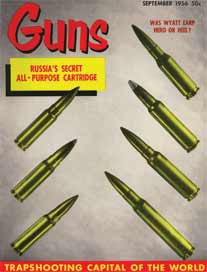
GUNS Magazine, September 1956


No such nonsense as a store-bought shotgun for 18-year-old Arnold Allen of Ada, Okla. He made his own. He used a three-quarter-inch pipe for the barrel, whittled himself a stock and used a small nail for the firing pin.
And no federal ninjas broke his door down and destroyed his life.

Of course, that was 50 years ago.

The September 1956 issue of GUNS Magazine is now online.

Also in this issue:
  • "Was Wyatt Earp Hero or Heel?" [Seeing as how he imposed "gun control" in Tombstone, my vote is for the latter, along with article author and GCA '68 proponent Hugh O'Brian]
  • "Russia's Secret All-Purpose Cartridge"
  • "Where Tommy Guns Are Shot By Civilian Marksmen"
  • and much more, including the classic period ads (featuring classic period prices).

Download your copy now, before it disappears from the site.

A Walk in the Park

Coleman wants officers to be able to arrest anyone carrying a gun in a city park and confiscate the weapon. A court ruling released last week by the 6 th District Court of Appeals in Toledo upheld that city’s law banning guns in parks...
They know their efforts to disarm violent criminals are futile, so this is aimed squarely at you, "law-abiding" CCW permit holders...

And you can bet when overlord Mike Coleman makes his announcement of the new law from a city park, he'll be flanked by the finest armed protection taxpayer money can buy.

Pennsylvanians Support Self-Enslavement

A new poll of likely voters in Bucks, Chester, Delaware, and Montgomery counties conducted by Lake Research Partners (see complete poll here in Word format) shows that suburban Philadelphia voters overwhelmingly support tougher laws to control the availability of guns and reduce gun crime. Support for tougher gun laws cuts across all demographic lines and includes Democrats, independents and Republicans.
I realize asking a different set of questions could produce different results, but we can't whistle through the graveyard past this one.

Most of our neighbors are ignorant of this issue and have strong emotional responses that are ripe for manipulation.

Democrats Call for Gun Laws

In other news, water is wet and lemons are sour.

Progressive Is as Progressive Does

This is what I’d expect of Florida, which recently passed a “shoot first” — also called a “shoot the Avon lady” — bill. I’d expect it of Texas too. But Minnesota? I grew up thinking of Minnesota as a socially progressive state.
I guess that all depends on how you define "progressive," Colonel Klink...I mean, Verlyn Klinkenborg.

We realize to an unreconstructed socialist police-stater like yourself that means being in thrall to the collective, but thank goodness there are still those willing to defy and resist lying pseudointellectual traitors. And it looks like they're making "progress."

Contemptible little Red, aren't you?

[Thanks to Jason M]

This Day in History: September 6

On this day in 1781, British Brigadier General Benedict Arnold, a former Patriot officer already infamous and much maligned for betraying the United States the previous year, adds to his notoriety by ordering his British command to burn New London, Connecticut.

Tuesday, September 05, 2006

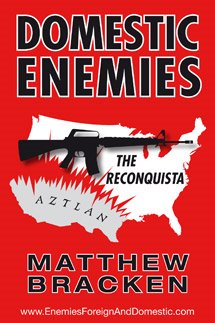
"Domestic Enemies"--An Interview With Matthew Bracken

I want my biases out on the table before I start this: It's no secret I'm a big fan of Matthew Bracken's first book, Enemies Foreign and Domestic, and said as much in my review last year.

I haven't read Matt's sequel, Domestic Enemies: The Reconquista. I've just started it, but admit I'm caught up in what I've read so far. Also, Jeff John at GUNS Magazine just gave me the green light to write a review for the magazine.


As I've said in prior announcments, Matt is going to be checking in today from time to time and answering questions from WarOnGuns visitors as time permits. If you have a question you'd like to ask him, just post a comment at the end of the interview.

That's about all the introduction we need. Let's jump right into the interview.

---------------------------------


DC: Without giving any spoilers, set the story up for me. How does Reconquista tie in with EFAD, and where do you take it from there?

MB: Reconquista begins five years after the end of EFAD, with a leading character from the first book in a detention camp for suspected terrorists. That is the only character from the first book who is carried over. The five year time period allows the reader to experience a significant deterioration of the state of freedom in America. The plot takes that character on a journey across the Southwest, which is then in the opening stages of a low-intensity civil war.

DC: Your sequel speaks to a very specific kind of subversion by a very specific demographic. What do you say to people who are concerned about xenophobic or racial implications? Can a person of Mexican ancestry enjoy this book and agree with its sentiments? How about a person with a libertarian “open borders” philosophy?

MB: I dismiss any charges of xenophobia or other racial implications out of hand. You either believe in the Constitution and the sovereign borders of the USA, or you don't. Millions of illegal aliens who have invaded the USA believe that the Southwest was "stolen" from Mexico, and that they have the right to take it back. This is totally bogus "junk history" which I would be happy to detail at any level. There are also millions of Americans of Hispanic descent who are loyal citizens who hold the Constitution and our sovereign borders dear. Many of the positive protagonists in Reconquista fit that description. The racists in this debate belong to groups like "La Raza," which are racist organizations on their face. As far as "open borders libertarians," I hope and trust that they will hate this book like the devil hates holy water. I consider them traitors and Quislings, and I despise them. I am unashamedly an American who believes in the rule of law, the Constitution, and defending America's sovereign borders.

DC: Apathy seems to be rampant among gun owners, with only a small percentage involved in basic activism—out of 80 million estimated gun owners, something like 5% are even NRA members, and harder core groups, like GOA and JPFO attract significantly fewer members. Do you believe that Americans who won’t do the easy things—petitioning, rewarding and punishing candidates, lending financial support to myriad efforts toward peaceful redress of grievances—would take extreme risks, put their lives, fortunes and sacred honor on the line, and actually take up arms to reclaim their Republic? If so, why?

MB: Most Americans will not even sign an on-line petition, much less put their lives, fortunes, and sacred honor on the line to save their Republic. Unfortunately they are too busy earning a living and paying their bills and their taxes to worry much about what will become of the nation they will hand over to their children. I believe that the USA is on the road to becoming a third world nation, and I feel great sorrow for our children. After 225 years we have finally managed to debase and squander our national legacy, and our children may well spit on our graves for our apathy and self-absorption.

DC: What has the response of gun owners been to this and your previous book? What kind of numbers do you need to get major publishing houses to set aside their prejudices and see the profit potential in introducing this book to the same mass audiences they appeal to with novelists like Tom Clancy?

MB: The 6,500 gun owners who have read EFAD love it and many of them tell me that it's the most important book they have read in many years. I hear that copies are passed from person to person and that is gratifying. It's extremely difficult for a no-name first-time-author to crack through the left-tilting PC-ridden world of mainstream New York publishing, which is why I opted to self-publish. The numbers I've sold via the internet, with no promotional budget, have finally gotten some national publishing attention. However, I don't hold out much hope for a serious publishing contract unless lightning strikes, the way it did for Tom Clancy.

A short anecdote: around 1980 or so, my father was a member of the Navy League in Baltimore, and Tom Clancy was an insurance salesman who had just written a book called The Hunt For Red October. Incidentally, Clancy graduated from the same high school in Maryland that I attended, ten years ahead of me. Clancy, who had no "real" publishing contract, was giving free lectures and selling his book off of tables. (Clancy had managed to obtain a small print run from the Naval Institute Press, which specializes in reprints of obscure naval histories.) At a Navy League function, my father bought a signed copy from the totally unknown author. Later, through a stroke of luck and some superb "guerrilla marketing," a copy of The Hunt For Red October was given to Ronald Reagan, who was photographed carrying it, and the rest is publishing history. (We still have our own signed first edition "Naval Institute Press" copy of Red October, but my dad had the habit of marking books up with underlining and marginalia, so it's probably worthless.)

However, in my case, I see no hope at all that our current President would be caught dead carrying Reconquista, which is a strong indictment against his open borders and pro-amnesty positions. In my case, I'll have to continue to grind out my own promotion via word of mouth, one reader at a time. The best promotion for my books are my books, but this type of promotion takes a long time.

DC: How about the “gun rights groups”? Did any support EFAD with reviews/recommendations, and have any shown an interest in promoting Reconquista? And same basic question—what kind of acknowledgment are you getting from talk radio programs, gun magazines, other media?

MB: Some small state-level gun rights groups have given me kudos, but the national groups such as the NRA have never indicated that they even received, much less read, the copies of EFAD that I sent to their officers with very nice letters. I'm not sure why this is, but that is their problem. I have a few theories.

A few gun magazines have carried reviews of EFAD for which I'm grateful, particularly GUNS magazine, which ran your review.

DC: Are you conducting your own publicity campaign? What about book-signing appearances at gun shows, talks at gun clubs, etc.?

MB: For Reconquista, I'm sending out books in clear poly mailers to a fairly large number of radio hosts and producers, mainly across the Southwest where the illegal alien invasion is a burning issue. I just moved from San Diego, and I can tell you that gun rights never rose above about "topic nineteen" on the list of talk radio subjects, but the alien invasion occupies more than half of every talk radio hour in the Southwest. Reconquista might get some traction on talk radio, even if I have to literally throw copies over the transom.

As far as gun shows, I've been fortunate to be invited to the SHOT Show the last few years by Kasey Beltz of Accu-Shot, who has been a big supporter ever since he read an early edition of EFAD. Just attending the SHOT Show has been a tremendous education. It is nice to be greeted at the SHOT Show by many gun-writers and shooters who are "names" in the industry. That has been very gratifying. I really haven't done book-signing appearances other than at the SHOT Show.

DC: I’ve read some comments that show you have a core of enthusiastic readers who obviously love your work. What can your fans do to help promote your book and get it before a wider audience?

MB: I have postcard-sized reproductions of the covers of both of my books, which folks can post on the bulletin boards of their local shooting clubs and so on. The cover cards are free for the asking through my website. It also wouldn't hurt if either of my books were mentioned on local talk radio, that's for sure. I've had maybe a dozen radio interviews from Tucson to Fairbanks discussing gun rights, and I'm told I'm a good guest. I think talk radio might lead to a breakout, especially concerning the topicality of Reconquista. But whether it does or not, I'm in this for the long haul. I'm a full-time writer now, and eventually I'll break through in a big way. I think my books convey important messages that need to be heard by millions of Americans, about the dangers facing our nation in the very near term.

DC: Is this a trilogy? Will we see Foreign Enemies in the next year or two?

MB: This is a trilogy, and the third book will be called Foreign Enemies. It will take place in an America that is shattered and experiencing a terrible economic depression and social disintegration. I would not put a time frame on when it will be finished. I just hope the national economy in two years is such that it will support endeavors like writing and selling novels.

Matt Bracken
Florida

---------------------------------


Please submit questions below by clicking on the "Comments" link. Mr. Bracken may not be able to get to all of them, but let's enjoy this opportunity as long as it presents itself. Also, if you haven't yet done so, please let your friends know about this interview so they can participate.

Focus on Medical Fraud

Being a murder capital is unlikely to help Hoosiers attract the kind of high-tech, high-paying jobs we all want. We think reasonable steps to prevent violence are as important and much cheaper than constantly trying to clean up the mess afterward.
So I prescribe a disarmed police state, where we "treat" everyone by force except the infected carriers!

Good Lord, doc. Your cure is worse than the disease.

[Thanks to Jason M]

We're the Only Ones Who Can Handle it from There Enough

Tanner said there are too many variables at play in situations in which robbers are threatening people with weapons. When criminals need to be disarmed, it's best to let officers who've had extensive training handle it.
Yes, never trust your instincts in a life and death situation, you inept fools. That's what "The Only Ones" are for.

[Thanks to Jason M]

This Day in History: September 5

On this day in 1774, in response to the British Parliament's enactment of the Coercive Acts in the American colonies, the first session of the Continental Congress convenes at Carpenter's Hall in Philadelphia. Fifty-six delegates from all of the colonies except Georgia drafted a declaration of rights and grievances and elected Virginian Peyton Randolph as the first president of Congress. Patrick Henry, George Washington, John Adams and John Jay were among the delegates.

Because I didn't post over the Labor Day weekend, here are the links for Saturday through Monday:

September 2- "Congress Founds US Treasury"

September 3- "The Stars and Stripes Flies"

September 4- "Bravery of Swamp Fox Wins Recruits at Blue Savannah"

Monday, September 04, 2006

Reminder: Bracken Interview Tomorrow

Been gone for the long weekend and haven't posted to the site, but just wanted to remind WOG visitors that tomorrow is the Matthew Bracken interview.

I hope you can join us, and that you help spread the word.

Friday, September 01, 2006

Firearms Industry Scores Major Victory in California Assembly; Microstamping & Bullet Serialization Bill Defeated

Legislation before the California Assembly (AB 352) that would have required microstamping of firearms and bullet serialization of all ammunition was defeated last night.

It'll be back.

Escaping the Village II: False Alternatives

I know I promised "Profiles in Apathy" as the next installment to my ongoing series on steps needed to restore gun rights, but the timeliness of the linked article needs to take precedence. I was going to cover this topic later.

A Second Amendment group is warning gun owners that a "massive gun control bill" is now working its way through Congress -- and is surprisingly close to becoming law.

Gun Owners of America also admits that it is the only national pro-gun group to oppose the "NICS Improvement Act of 2005" (H.R. 1415)....

Okay with NRA


The National Rifle Association takes a less ominous view of the bill.

"This bill...would improve availability of criminal history and other records for conducting background checks on firearm buyers," says an analysis on the NRA's Institute for Legislative Action website.
Why doesn't that surprise me?

Still, missing from the debate is a system proposed years ago that would allow for checks without identifying individual gun owners. Did you know such a proposal existed?

I thought not.

It been ignored by the major gun groups.

The Blind Identification Database System, or BIDS, was developed by my friends Russ Howard and Brian Puckett. Note that they are the first ones to admit that no prior restraint is constitutional, and that background checks are ineffective at keeping guns out of the hands of "prohibited persons" (as if there is government authority to prohibit or put prior restraints on anyone who is not incarcerated).

But what BIDS would do is reduce the amount of infringement the government is currently forcing on us, and preclude them having a registration list of identified gun owners as NICS provides.

Anyone who has read my work knows I prefer no system--my long-stated position is anyone who can't be trusted with a gun can't be trusted without a custodian. But I have also long admitted I am a minority, and stipulate that those who tout the benefits of incrementalism view people like me as unrealistic "absolutists" (hell, an NRA rep once warned people that Brian and I were "wild-eyed extremists"!)

So here's my challenge to the majority: Why not BIDS? So far, the only objection I've heard is "it's not politically feasible."

Yeah, I guess if all the major gun groups are going to suppress it from the debate, that's probably correct. Let's just all give up before we even engage. That'll win back our gun rights.

Click on the BIDS link above and save your own copy of this proposal.

My guess is only a few gun owners will even take the time to read the whole thing. Which brings me back to the start of this post--I still need to work on "Profiles in Apathy."

"Once I Started Reading, I Didn't Want to Stop"

I thought WoG visitors would be interested in the reviews starting to come in at Amazon.com for "Domestic Enemies: The Reconquista."

I just got my copy and will begin reading it over the long weekend. I hope it's as good as "Enemies Foreign and Domestic," and as good as these early reviews indicate.

Don't forget, the Matthew Bracken Interview is 4 days away...

We're the Only Ones Da Bomb Enough II: Shoulda, Coulda, Woulda

Called "a menace to society," by a judge Monday, Jon Bartlett was sentenced to 4 ½ years in prison, which officials said should finally get him off the Milwaukee Police Department payroll.
"Should?"

The creep was already convicted.

And it's still just "should"?

Just what does it take to get an "Only One" off the backs of Milwaukee taxpayers?

Because of a state law that applies only to Milwaukee police and advocated by the politically powerful police union, city taxpayers were forced to pay Bartlett his full salary and benefits since he was fired along with eight other officers in May 2005 for their roles in the Jude incident. Since then, he has received more than $100,000 in pay and benefits...

Legislation to change the law and stop paying fired Milwaukee police officers died last fall when all Republicans on the committee voted against it.

Ah yes--the party of limited government and law and order. Anybody from WI have a handle on what's up with that?

[Thanks to AB5SY]

This Day in History: September 1

Richard Penn and Arthur Lee, representing the Continental Congress, present the so-called Olive Branch Petition to the Earl of Dartmouth on this day in 1775. Britain’s King George III, however, refused to receive the petition, which, written by John Dickinson, appealed directly to the king and expressed hope for reconciliation between the colonies and Great Britain.
Our modern day rulers ignore our petitions, too.

Thursday, August 31, 2006

Gun Dealer Stings Back

Mayor Bloomberg has been hit with another lawsuit in connection with his campaign to crack down on illegal guns.

A South Carolina gun dealer became the second storeowner to sue after Mr. Bloomberg targeted it a few months ago in an undercover sting operation designed to stymie illegal gun sales.

The lawsuit, filed in South Carolina, seeks damages and claims that the city smeared the storeowner's reputation.
Looks like my latest Guns Magazine article, just now on the newsstands but written last June, wasn't that far off the mark...

Shameless Plug: "The Sting"

Bloomberg’s team may not have uncovered crimes at all, and may not have committed any themselves. This may be all about generating publicity for his lawsuits, and the sales could have all been conducted in a perfectly legal manner, despite media hype.

"The Sting" is my Rights Watch column for the October 2006 issue of GUNS Magazine, on sale now at newsstands that do their best to flood the streets of New York City with gun information.

Why not buy a copy for yourself, or make a straw purchase for someone else?

BONUS: See page 106 to find out how you can win a Benelli Supernova 12 gauge shotgun

5 More Days...


...until "The Interview".

Meanwhile, Matthew Bracken informs me John Ross has written a review of "Domestic Enemies" over at The High Road.

I can't give you a clip from that because I'm going to be writing my own review and don't want to see what Ross has written, lest it influences my own reporting.

We're the Only Ones Ignorant of the Law Enough

Charges that an Illinois State Police sergeant illegally possessed a machine gun were dismissed Wednesday by a federal judge, who ruled that the law was "unconstitutionally vague" as applied to him.

...U.S. District Judge David R. Herndon dropped the charges against Sgt. James V. Vest... Herndon's 26-page order says the confusion is over the federal law's exception for police officers, and whether Vest could reasonably be expected to know whether he was breaking the law.

Ignorance of the law is no excuse--unless you're an "Only One."

We're the Only Ones Exploring Enough

A suspended Alhambra police officer was charged Wednesday with 10 criminal counts for allegedly molesting 2 teenage boys, including one who was an Explorer with the Baldwin Park Police Department.
What a waste, being an "Only One" and then blowing it.

A Sophomoric Opinion

While allowing a licensed person to carry a gun on campus sounds like a good idea...I strongly disagree.
Sophomore Renee Maisel illustrates the dangers of allowing a shallow and ignorant little girl's opinions to have any bearing on the rights of free men and women.

This Day in History: August 31

Samuel Mason, a Patriot captain in command of Fort Henry on the Ohio frontier, survives a devastating Indian attack on this day in 1777.

Wednesday, August 30, 2006

Coming Tuesday, Sept.5


A WarOnGuns Exclusive

The Matthew Bracken Interview

Mark Your Calendars

Tell Your Friends

Prepare Your OWN Question


We will be discussing his new book, Domestic Enemies: The Reconquista.
Mr. Bracken will be checking posted comments that day and answering questions as time permits.

Lest Ye Be Judged Follow-Up

Comment poster Alex observed that pointing a gun in Georgia is classified as a misdemeanor. I had referenced Georgia law that indicated brandishing a gun could be treated as a felony.

Say Uncle speculated there could be prosecutorial leeway, which this article confirms.

Pointing or aiming a gun or pistol at another occurs when someone purposefully and with no legal reason points a gun at someone else, according to Georgia case law. Courts have held it doesn't matter if the gun is loaded.

One example of when the more serious felony charge of aggravated assault occurs is when someone uses a deadly weapon that could or does cause serious injury.

"When can you point a gun at someone and not threaten serious bodily harm?" said Russell Gabriel, director of the Criminal Defense Clinic at The University of Georgia. "I don't know. It's sort of a rhetorical question."

Gabriel said that in his opinion it is somewhat absurd to have both laws on the books, though the existence of both charges gives prosecutors some discretion in how to charge someone. "The law doesn't always make sense," he added.

Sydney Gun Crimes Double

In inner Sydney, robberies with a firearm increased by 111 per cent over the last two years...
Who could have guessed?

Texas Bull

Jones gets to use the weapons to create a longhorn sculpture for the city's Butler Longhorn Museum, which honors the bovine bloodline that originated in League City.
Yep, honor herd animals.

Honor chattel.

[Via KABA Newslinks]

This Day in History: August 30

"The American Revolution" category over at The History Channel website appears to be down again. But you can bet your tricorne something happened.

Second Amendment Carnival IV

Free Constitution presents links to commentary from sites promoting the right to keep and bear arms.