






Those attending the 2008 NRA Annual Exhibits at the Kentucky Expo Center will have a unique and special opportunity this year as the Supreme Court considers the meaning of the Second Amendment in the DC vs Heller gun ban case. The Second Amendment Films booth (#1551) will have two notable independent Second Amendment scholars in attendance, David T. Hardy and David E. Young, both of whom have links to the Heller case.
David Hardy, attorney, author, and producer will be promoting his new documentary film, In Search of the Second Amendment, which is available on DVD. In addition to authoring the sourcebook, Origins and Development of the Second Amendment, and many law review articles advancing the individual rights nature of the Second Amendment's protection, David Hardy is a co-author of the amicus brief filed with the U.S. Supreme Court in the current DC vs Heller case by Academics for the Second Amendment, and he attended the oral arguments before the Court.
David Young, historical scholar, editor, and author will be promoting his new definitive history of the Second Amendment, The Founders' View of the Right to Bear Arms, as well as The Origin of the Second Amendment, the complete Constitutional Era document collection that he edited and published. Mr. Young's books have been cited to the U.S. Supreme Court a total of fifty-five times in various briefs filed in the current DC vs Heller gun ban case, and his document collection was extensively relied on in prior appeals court pro-rights decisions leading to the current case.
Anyone attending the NRA Annual Exhibits who is interested in the Second Amendment's history or the legal ramifications of the current DC vs Heller case before the U.S. Supreme Court will be able to ask questions and discuss their points of interest with these two independent pro-rights Second Amendment scholars, each of whom has a completely different background. David Hardy, legal professional, views the entire subject from a legal perspective, while David Young, historian, relies entirely on period historical sources.
Second Amendment Films will be selling DVD copies of David Hardy's new documentary, In Search of the Second Amendment, as well as copies of David Young's new book, The Founders' View of the Right to Bear Arms, and his document collection, The Origin of the Second Amendment, at NRA Exhibits Booth 1551.
For anyone attending the 2008 NRA Exhibits, stop by, have a chat, and pick up the very latest and most complete Second Amendment related information available anywhere.
David T. Hardy's URL is: http://www.armsandthelaw.com/
David E. Young's URL is: http://www.secondamendmentinfo.com/
Showing posts sorted by relevance for query David T. Hardy. Sort by date Show all posts
Showing posts sorted by relevance for query David T. Hardy. Sort by date Show all posts
Saturday, May 03, 2008
Hardy and Young will be Giving 'em Heller at NRA Exhibits Booth 1551
From David E. Young:


Monday, February 05, 2007
"In Search of the Second Amendment"--An Interview With David T. Hardy

A growing body of serious research, led by eminent professors, historians, lawyers and Constitutional scholars, is providing overwhelming evidence that “the people” of the Second Amendment refers to you and me.That introduction is from the March 2007 issue of GUNS Magazine, where I review attorney and author David T. Hardy's new documentary, "In Search of the Second Amendment."
My conclusion:
David Hardy has given us an important tool to use in educating ourselves and others.Here's a brief summary about Mr. Hardy and his film:

David T. Hardy served as producer and director of In Search of the Second Amendment. He is an attorney and Second Amendment author, whose 1974 law review article, “Of Arms and the Law” played a key role in beginning the academic rediscovery of the Second Amendment.And now on to the interview...
Hardy is author of five books, including “Origins and Development of the Second Amendment” and the N.Y. Times bestseller “Michael Moore Is A Big Fat Stupid White Man,” which rebutted Moore’s slander of the NRA, Charlton Heston, and gun owners. He is also author of twelve law review articles, including one on firearms laws that has been cited by the U.S. Supreme Court and eleven of the thirteen U.S. Circuit Courts of Appeals.
“I spent thirty years researching the right to arms, and four years of my life creating this film. My purpose was to produce something not only educational, but compelling. There’s been enough preaching to the choir. I wanted to produce something that would win hearts and minds, that would convert anyone with an halfway open mind into someone who appreciates and values the American right to arms.”
---------------
DC: There are plenty of books on the subject of the Second Amendment. Why do we need a DVD?
DH: There are indeed plenty of books on the right to arms -- almost all of them written by people interviewed in the documentary. If you want a thorough grounding in the Second Amendment, you can buy 2-3-4 of them, and spend a week or two reading them and trying to memorize their content. Or you can watch the movie, and learn all you need to know in two hours. And this time, you'll remember it all.
It's also great for educating your children, and winning over the undecided. A week's reading assignment will be a chore for the first, and laughed off by the second. Offer them an entertaining and educational movie, and you'll win them over.
I mean -- how many people have read a book on 18th century naval history, but watched "Master and Commander?"
DC: Give us a synopsis of your video—what should someone who is thinking of buying it expect?
DH: The *complete* story of the right to arms, beginning with the earliest Britsh law, moving forward to the colonies, the Constitution, and the Bill of Rights. From there to the earliest American legal commentators, all of whom said it was an individual right. Then the Black experience -- disarmed under Slave Codes, and then under the Black Codes, which led to the 14th Amendment (1868), which was meant to stop state disarmaments of people. Then the use of arms in the civil rights period -- "nonviolence" got the press, but a lot of civil rights workers survived because they were armed. Finally, the current value of the right to arms, genocide, preservation of democracy, 2.5 million defensive uses per year.
This isn't me talking (I do the narration, just to fill gaps) but twelve professors of constitutional law, attorneys, Prof. Kleck on the 2.5 million uses, two armed civil rights workers.
DC: What do you say to someone who says times have changed, that history is interesting but not relevant to the present? After all, it’s not like we have citizen militias any more.
DH: And we saw the impact of that in Hurricane Katrina. Organize people, and they're a pack. Don't, and in a disaster they become a helpless herd.
Several of the professors address just that question. At a practical level, Prof. Reynolds discusses how his idea of an international right to arms, to prevent genocide, is gaining some traction. Prof. Kleck discusses 2.5 million defensive uses. Two attorneys discuss how the police have no legal duty to protect you.
And Prof. Barnett points out that if people want others to respect their rights, they must be prepared to respect our rights to arms; any method that can be used to destroy the second amendment can be used to destroy any other right, as well.
DC: Who is your audience, or put another way, what’s your plan to get your message outside the circle of gun owners who agree with you, especially to people who have formed their opinions based on what they learned in school or picked up from the mainstream media?
DH: My first effort is to get it out there -- which means to activists. They can become an Army of Davids, to use Prof. Reynolds' book title. With this DVD, each gunowner can become a one-man or one-woman PR firm for the right to arms.
From there, I can try to expand, to radio talk shows, that manner of thing, and carry the message further.
To help them with that, I put a license on the website. After April 1, any purchaser can show the DVD on local cable TV without limit. The antis have no comparable tool. We can swamp them.
DC: You make a point of illustrating the role firearms played in the defense of civil rights. Why is it that today’s minority leaders not only don’t tell their followers about this history, but many actively promote citizen disarmament in the very communities where individuals are most at risk from violence?
DH: I suspect it's largely a matter of fashion. "Nonviolence" caught the media eye, and nobody is going to go against that tide. But the civil rights workers I have in the film said that, while the leadership back in New York or wherever was appealing to nonviolence, most civil rights workers went nowhere without a gun. One says that when he came into the office after being chased by the Klan, all the others asked him why he didn't use his gun, and he was startled when one pulled a revolver out of his pocket, gave it to him, and said it was a loaner, he had another one in the car.
DC: Do you think a bunch of academics are going to appeal to “ordinary” people?
DH: These ones will. All are incredibly articulate -- no eggheads here. Actually, law profs are rarely eggheads. They're training people to survive in a courtroom, not a library.
DC: Are you getting much help spreading the word from pro-gun organizations, gun magazines, websites, etc.?
DH: Some. NRA Civil Rights Defense Fund was very, very helpful. Gun Owners' Foundation helped, too. Paladin Press and Ruger helped as well.
Gun Owners and JPFO have ordered some to distribute, and some gun bloggers have helped to promote it. I've sent review copies to a number of gun magazines, but the only response has been from Gun Week, Soldier of Fortune, and you.
DC: What can supporters do to help you promote this documentary and expand its audience?
DH: Get one, or better yet two, and give the spare to your school or library. Show it on cable TV. If you have an email list, tell them about it.
DC: Assuming you recoup your production costs, what are your plans to grow your audience?
DH: If I can make enough, I'd like to start running ads (I had only enough for one to date) to get it out there. I'd also like to hire a publicist to lobby for radio talk show coverage.
I may this year start work on a followup that will deal with the history of the modern gun and antigun movements. I've got 30 years of research there, too. There's history there, and nobody's getting younger. We've already lost the two key players, Harlon Carter and Neal Knox.
---------------
I'd like to thank Mr. Hardy for participating in this interview, and for putting up with my playing "Devil's Advocate" on a few of these questions.He has agreed to check in from time to time today to answer questions from WarOnGuns visitors. Please--it will be appreciated if everyone follows a few simple ground rules: Stay on topic, give others a chance, and keep your question brief. Just post your question below as a "Comment," and he will do the same--please also note that we don't expect him to be hostage to his keyboard all day waiting for queries to pop up. It's OK to ask a question if his answer to the previous one hasn't appeared yet--he'll get to them as he checks in.
I haven't established a cut-off time for this--he'll let us know when he needs to check out.
---------------
Here's how you can order your own copy of "In Search of the Second Amendment":
Send check or money order for 24.95, plus $2 s&h (Arizona residents add $1.52 sales tax) to:
Second Amendment Films
8987 E. Tanque Verde
PMB 265
Tucson AZ 85749
Or click on the "Buy Now" Visa/Mastercard icon in the left margin of the documentary website.
UPDATE: INTERVIEW OVER, THANKS FOR CHECKING IN, BUT THIS TOOK PLACE FOR ONE DAY ONLY, SO COMMENTS ARE NOW CLOSED.
Thursday, February 01, 2007
WarOnGuns to Interview David Hardy
I'll be interviewing attorney and author David T. Hardy on Monday about his new documentary, "In Search of the Second Amendment."
As with the Matt Bracken interview, Mr. Hardy will be checking in on the comments from time to time during the day and answering your questions.
Mark your calendars and think of what you want to ask--this should be good.
As with the Matt Bracken interview, Mr. Hardy will be checking in on the comments from time to time during the day and answering your questions.
Mark your calendars and think of what you want to ask--this should be good.
Monday, January 14, 2008
How YOU Can Be a Part of History
I first told you about Academics for the Second Amendment here.
They need financial help to fund their legal work on behalf of Heller. As we've just seen over the weekend, the novel betrayal by the "Vote Freedom First President" has made the need for compelling scholarship even more critical.
The work these men are doing on our behalf can be all consuming--they are devoting their time, their labor and their expertise to help bring us the best outcome possible.
We can continue to stand by as spectators, or we can do something to pitch in. Please help out by sending a donation and by spreading the word.
Wouldn't it be nice if our side prevails to know that you helped make it happen? Wouldn't it be pathetic if we lose and you know you didn't?
To reiterate who these guys are and their qualifications:
David T. Hardy
Clayton Cramer
Joseph E. Olson
[Via Greg L]
They need financial help to fund their legal work on behalf of Heller. As we've just seen over the weekend, the novel betrayal by the "Vote Freedom First President" has made the need for compelling scholarship even more critical.
The work these men are doing on our behalf can be all consuming--they are devoting their time, their labor and their expertise to help bring us the best outcome possible.
We can continue to stand by as spectators, or we can do something to pitch in. Please help out by sending a donation and by spreading the word.
Wouldn't it be nice if our side prevails to know that you helped make it happen? Wouldn't it be pathetic if we lose and you know you didn't?
To reiterate who these guys are and their qualifications:
David T. Hardy
Clayton Cramer
Joseph E. Olson
[Via Greg L]
Wednesday, December 22, 2010
Second Amendment attorney: ATF’s proposed long gun ‘emergency’ regs illegal
Further, the report claims “The regulation proposed is outside the statutory grant of authority to record information about multiple sales of firearms,” a concern Second Amendment scholar, author and attorney David T. Hardy details on his Of Arms and the Law blog... [More]Today's Gun Rights Examiner column clears up some confusion caused by a bureaucrat who doesn't want to confuse us as he confuses usurpation with legitimate authority.
Clear?
Then tune in to Trigger Sports--it's Pre-recorded! this time (don't be confused, just watch and enjoy), and resolve to surround yourself with guns, guns and more guns...
The more people you share the link with, the fewer will end up being confused by all this...
Saturday, September 15, 2007
Clayton Cramer to Appear at Red's
As I reported earlier we will be premiering David T. Hardy's Documentary In Search of the Second Amendment in Twin Falls. Hardy has spent 4 years working on this documentary and it is a must see.
On October 3rd, there will be a presentation before the film by historian Clayton Cramer, who is the author of the book Armed America and also appears in the film.
I hope Ryan has notified the local press to come down and cover this. If the attendance is not overflow/SRO, I'd sure like to know why not.
Is the gun store you patronize a leader in protecting the rights of the communities they serve, or merely a merchant? If the latter, have you and your shooting friends taken the time to approach and educate them on the real need for gun shops to supply freedom information as well as freedom tools?
Nothing will change unless we take it upon ourselves to change things. I hope that's not news to anybody.
Thursday, April 03, 2008
Hardy Documentary to Feature at Film Festival
From David T. Hardy:
I trust all WarOnGuns regulars have already seen it, bought a copy, shared it with others? Right?
I am happy to relate that my documentary, "In Search of the Second Amendment," will have a festival premiere at 10 AM next Saturday, April 5,at The Backlot Film Festival in Culver City (western LA), California.If you live in SoCal, spread the word among your friends and make plans to go. Hopefully the NRA Members Councils are all pushing their people to attend. And hopefully, some teachable folks outside of the RKBA community will be curious and want to give it a look.
http://www.backlotfilmfestival.com/
http://www.backlotfilmfestival.com/program.htm#Saturday
http://www.secondamendmentdocumentary.com/
I'd appreciate if those who blog or maintain email lists could give it a mention. Admission is only $5 per film, and better attendance gives a better shot at getting media coverage.
I trust all WarOnGuns regulars have already seen it, bought a copy, shared it with others? Right?
Thursday, October 04, 2007
"In Search of the Second Amendment" Premieres at Red's
The Premiere of David T. Hardy's Documentary In Search of the Second Amendment opened to a great crowd in Twin Falls that included Twin Falls City Councilman Trip Craig and Vice Mayor Glenda Dwight.
Author and Historian Clayton Cramer made a presentation following the film.
Getting local politicians to show up is a definite plus. The choice of film and inviting the guest speaker were inspired.
Ryan certainly is emerging from his trials as a natural leader, isn't he?
Saturday, October 13, 2018
Book Shows How Gun Advocates Can Influence the Public on Mass Killings

"We will first examine the nature of mass and school killings, and then attempt psychological profiles of the killers, and examine the role that the media may play in motivating them. Lastly, we will look at possible solutions, and assess the chances of each approach working. For reasons which will be explained, the killers will not be named in this book." [More]A favorite line exploited by gun-grabbers is "Something must be done." David T. Hardy tells us what. And surprise! It doesn't involve an assault on your rights.
Tuesday, October 06, 2015
Support for Kleck
Using a 5,200 person telephoneDavid T. Hardy found a study from 1997.surgery[survey-- see comment by Ed], authors conclude that annually about 1.9 million people draw a gun during a home intrusion, but don't actually see the intruder, another 503,000 draw a gun and do see the intruder and (not surprisingly) 497,000 report the intruder fled in response to the gun. [More]
Thursday, September 06, 2007
A Reasoned Approach
Next, how about we throw the 2nd Amendment into the trash heap of well-meant but stupid historical statements. There is no right way to interpret it, and we're just being intellectually dishonest if we pretend there is.
Of course there's a right way to interpret the Second Amendment, Mark. Just because you say there's not doesn't make it so.
Be intellectually honest and do some research before acting like you're an authority and obscuring the issue.
Start by getting a copy of attorney David T. Hardy's "In Search of the Second Amendment" DVD, which interviews leading Constitutional scholars and examines the historical record on how the amendment was developed and the intent of the Founders. If you're going to set yourself up as an authority with credentials to negate evidence presented by figures like Kates, Polsby, Levinson, Halbrook, Malcolm, Amar, Barnett, Cottroll, Kleck, Lund, Johnson, Innes, Reynolds, Volokh, et al., then let's party.
Educating yourself so you know what you're talking about would be the "reasoned approach." Otherwise, you just come across as another self-impressed dilettante with a fashionable opinion and a following of equally shallow and uneducated sycophants.
Wednesday, April 09, 2008
Clayton Cramer Interview
 As announced earlier, historian, software engineer and Second Amendment activist Clayton Cramer is running for Idaho State Senate (District 22).
The author of numerous books and publications, Mr. Cramer played an instrumental role in proving that "Arming America" by Michael Bellesiles was based on fraudulent research, resulting in revocation of the Bancroft Prize and Bellesiles' resignation from Emory University. Cramer's work has been cited in RKBA-related legal cases, such as Emerson, and he recently devoted his knowledge and research skills to the current Heller case,partnering with attorneys David T. Hardy and Hamline University's Joseph E. Olson on the brief filed by Academics for the Second Amendment.
WarOnGuns caught up with Cramer to discuss his political campaign. Here's what we discussed:
DC: So--why in the world are you subjecting yourself to this? Has representation for people with conservative and libertarian leanings really been so poor in the 22nd district?
CC: Senator Corder, while in some respects somewhat conservative, has made some votes and introduced some bills that just make me scratch my head in amazement. The one that caused me to run against him was his sponsorship of S.1323, which proposed adding "sexual orientation and gender identity" to Idaho's employment discrimination law. I often describe myself as a conservative with libertarian leanings. Here was a bill that managed to offend both sensibilities at once. What consenting adults do in private should be none of the government's business--and it doesn't matter if it is employment or sodomy.
I've developed a grudging tolerance of anti discrimination laws based on race and sex because for decades, both federal and state governments either directly discriminated, or required private businesses to do so. Read Plessy v. Ferguson (1896), the case that made "separate but equal" the law of the land. It was a Louisiana law requiring railroads to discriminate against blacks--and "the refusal or neglect of the officers, directors, conductors, and employees of railway companies to comply with the act" would leave them personally liable. I can give you many other examples of such laws requiring racial discrimination against Asians. Similarly, West Coast Hotel Co. v. Parrish (1937) involved a Washington State law that set working conditions for women specifically to drive them out of the workforce.
With this history, I can grudgingly accept the argument that anti discrimination laws served a useful purpose for destroying discriminatory presumptions. I get a bit less comfortable with adding "sexual orientation and gender identity" to the list--especially with this week's freak show event, the "pregnant man" in California.
Senator Corder also voted against making English the official language of state business (which should be a no brainer), and against adding a protection of the right to hunt and fish to the state constitution. Right now, these are not in danger--but if enough anti hunting sorts move here, that could be a problem. Best to get those protections in place now.
DC: Why you? What does Clayton Cramer bring to the job that makes you the most qualified candidate?
CC: There's only one other candidate in the Republican primary! Part of why I moved to Idaho is that it is a very conservative place--a good place to raise kids, and a good place for gun owners. I want to keep it that way. I'm afraid that Senator Corder is in danger of Californicating this state.
DC: You say your opponent is rated C by NRA. That's pretty poor for an Idaho Republican. Why such a poor grade?
CC: When I received the NRA ratings in 2006, he was listed as a C. When I spoke to someone at NRA-ILA recently, they indicated that he was a D in 2004, a C in 2006--and seems to be improving. I wasn't able to get a detailed description of what gave him such a bad grade in previous years.
DC: If you're elected, give some examples of "gun rights"-related legislation you would be a leader on, including new measures you would propose or existing laws you would fight to modify or repeal altogether.
CC: One of the issues that a lot of states are grappling with right now is parking lot bans. Most large companies (including my employer), have bans on firearms at work. I can understand their reasoning, at least in the buildings. You can't just walk in the front door where I work. There are significant security barriers that would significantly prevent a spree shooter from entering the building, so there's really not much reason for anyone to need to be armed in the building. But the parking lot creates a different set of problems. There are people who have significant drives to and from neighborhoods where having a gun available is perhaps a good idea. I see no good reason for any employer to prohibit a person with a license to carry from having a gun in their car in the parking lot, and I see some good reasons why some employees might want that gun there.
At the same time, I am reluctant to have the state government passing laws that get unnecessarily in the middle of the employer/employee relationship, or interfere with private property. I think the strategy that might make the most sense is to see what can be done about creating a carrot and stick approach with respect to liability: statutorily exempt employers from any civil liability for injuries caused by a licensed employee having a gun secured in a car in the parking lot (which is effectively zero risk); create an obligation that an employer has for injuries that a licensed employee suffers because they were unable to protect themselves on their way to or from work.
The employer can still have their parking lot rules if they wish, but the consequences of exposing employees to unneeded danger now fall on who put the employee at risk: the employer.
DC: What's it cost to do something like this? What's your plan to raise that much money?
CC: Unlike California, surprisingly little. The filing fee was $30. I've raised more than a thousand dollars so far, almost all through the website http://www.cramerforsenate.org/index.shtml, and it is quite common for members of the state senate to spend $7000-$10,000 in an entire election cycle. Remember that there are about 1.5 million Idahoans, and 35 members of the state senate. In the 2006 general election, about 10,000 people in my district voted for members of the U.S. House of Representatives. It's government on a small scale.
DC: Give us the timeline you're facing. When's the first contest? What do you need to do between now and then?
CC: The primary is May 27. I had something of a late start, since I made the decision to run the day before the deadline. (I was off in D.C. for the Heller case.) I'm still getting organized on this--putting together campaign flyers, organizing speaking events, filling out interest group questionnaires, and meeting with lobbyists. But at least they buy lunch!
The good news is that because the district is so overwhelmingly Republican, if I win the primary, winning the general election should be fairly easy. I won't say it is a walk in the park--the Democrat will work hard to defeat a political novice, and I expect that the many enemies that I have made over the years will pour money into the Democrat's campaign.
DC: Tell us about your rival--how much tenure does he have, how much of a machine? What are you doing to establish an organization with a realistic chance of competing? And as a follow-up, what benchmark milestones do you need to set up to make sure you're on track with campaign goals?
CC: Senator Corder was first elected in 2004. From conversations with a number of different Republican activists, it appears that Senator Corder has managed to upset much of what might be called the Republican machine. Some of the upset is personalities; I'm told that Corder used the phrase "knuckle-dragger" to refer to certain other Republican legislators, and this has not helped him. The sexual orientation bill has also produced a mixture of head scratching and irritation as well.
Benchmark milestones? Uh oh. I have lots of experience with lots of things, but this is not one of them! I have fourspeaking engagements set up so far; I've just started sending out press releases to newspapers (none of whom I expect will be supportive of my effort). The campaign website is up and accepting contributions. I'm just sending out my first mailing--one targeted to the surprising number of Federal Firearms Licensees in my district.
DC: A lot of Republican politicians run from the gun issue. Sure, they give platitudes, but that's mostly when cornered, and there's always that sense they're somehow uneasy talking about it--particularly not wanting to scare off the well-heeled and the contributions they represent. I've always felt that a true leader would take it on himself to initiate discussion and use the privilege of a public platform to educate and inform the electorate--you know, bringing light to darkness, replacing ignorance and fear with reason. What are your plans along these lines?
CC: This is probably one of the more gun-friendly districts in Idaho--maybe America? District 22 consists of Boise County (which doesn't include the CITY of Boise) and Elmore County. The biggest city in the entire district is Mountain Home Air Force Base. Mountain Home had 11,143 people at the 2000 census. Glenns Ferry has about 1600 people. Idaho City, Horseshoe Bend, Garden Valley--none of them are that large.
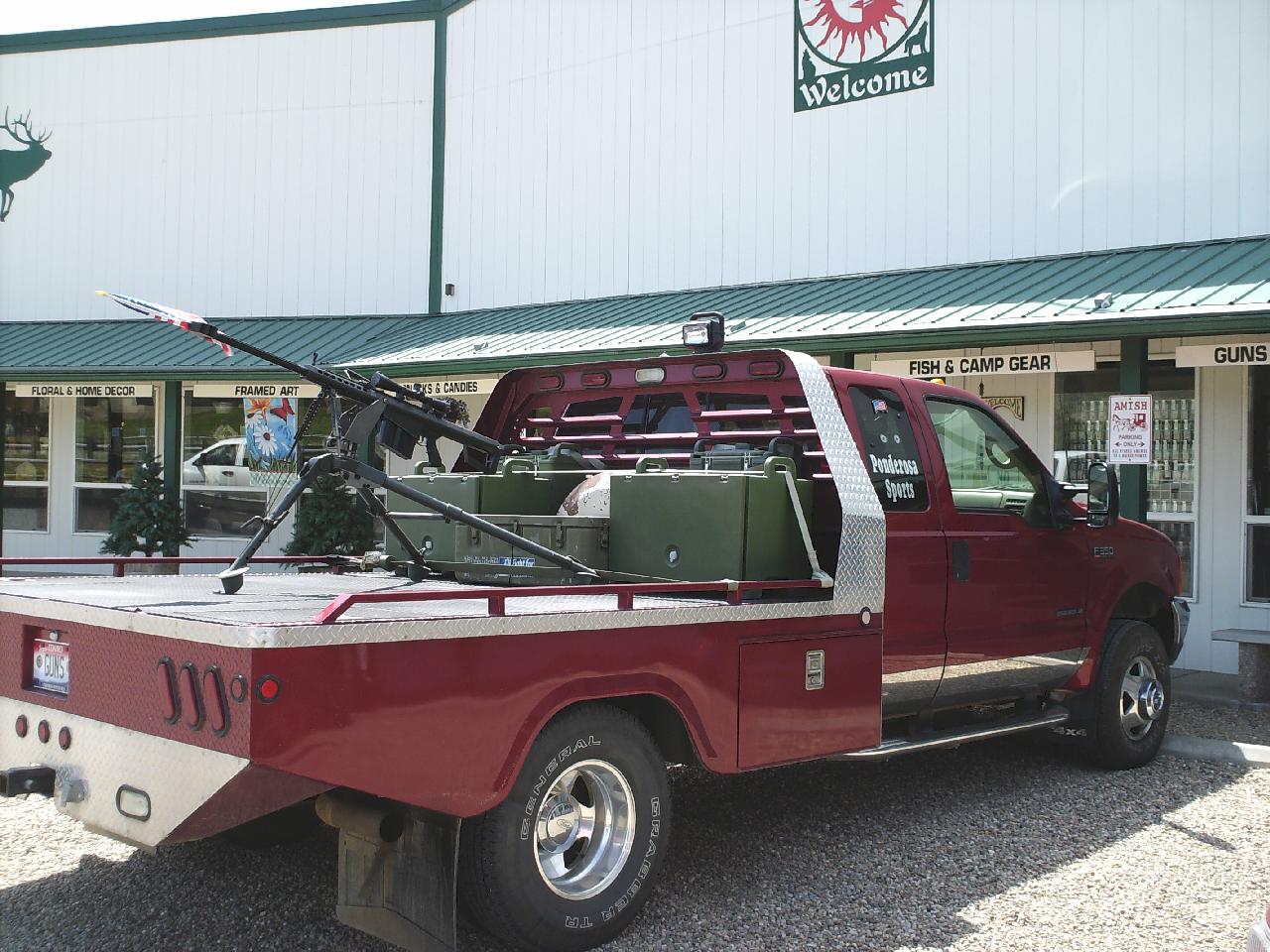
People hunt here. Getting my house built was greatly delayed by the start of elk season. I live just outside of Horseshoe Bend--which has a mandatory gun ownership law. Ponderosa Sports, a combination gift shop and gun store north of town has this rather unique vehicle in the parking lot. Yes, that's a Barrett Light .50 in the bed.
I don't think that I am going to be so much defending or explaining gun ownership to my district, as defending or explaining gun ownership to the more urban members of the Idaho legislature--if I get elected! And the worst Idaho legislators about gun control are generally not all that bad!
DC: Tell me about the demographics in your district--party affiliation, age, race, income, education...what importance does the "gun rights" issue play? Will there be much resistance in your district from those who consider guns a liability?
CC: Based on the 2006 general election results, it appears to be about 64% Republican voters. The population is overwhelmingly white, fairly normal distribution on age--although Elmore County, where the Air Force Base is located, is heavily male: 123 men for every 100 women. Household incomes are low: $35,000 per year in Elmore County, just under $39,000 in Boise County. My involvement in gun rights activism won't be a liability here--but an asset.
DC: Where do you stand with the party? Are they going to resist someone going after their guy? Have you been meeting people and reaching out for allies?
CC: I am under strict orders not to say who asked me to run--let's just say that lots of people of considerable importance among Idaho Republicans personally asked me to run. So far, I am finding that not only do Republican activists around the state want me to unseat Corder, but so do ordinary citizens. One of the people here in town that I deal with on a regular basis knew that I had signed up, and I was pleased to find out that he knew about Corder's sexual orientation bill--and found it incomprehensible why he sponsored it.
DC: How about media contacts? We know you have plenty of interest within the RKBA Internet community, but are you making contacts and building bridges with established local media?
CC: There are two newspapers in the district; the Idaho World, which is a weekly--and the oldest continuously operating newspaper in Idaho (est. 1863), and the Mountain Home News. I have good relations with the reporters for the Idaho World, although I rather suspect that they are going to back Corder. The Idaho Statesman is the major newspaper in this state, based out of the capital city of Boise. While outside our district, we are close enough to cover. They have occasionally published opinion pieces by me--one about mental illness and mass murder just a few days before I filed to run. I'll be curious to see how they cover the race. Like most newspapers, they tend to lean liberal on social issues.
DC: So how do people help out? How do they join your campaign? How do they contribute?
CC: There's a contributions page on http://www.cramerforsenate.org. And if you live in the district, or you have friends or relatives in the district, it's amazing how little encouragement it takes to persuade people to vote for one person they don't know over another person that they don't know! I'm trying to get voters in the district to invite neighbors and friends over for coffee with the candidate, so that I can explain why I think I'm a better match for the voters than Corder.
DC: Anything else you'd like to say to WarOnGuns visitors before we open things up for their questions?
CC: Yes. I know that gun rights activists tend to be split between social conservatives and libertarians. I'm definitely a social conservative--although not quite as doctrinaire as some. For example, I think that those who want to dramatically restrict abortion need to spend a lot more time persuading their opponents before passing more laws. There is a strong case that criminal laws should reflect not just 51%, but a very overwhelming consensus. Trying to enforce laws when 30% of the population strongly disagrees produces enormous struggle--and accomplishes very little good.
----------
Thank you, Clayton Cramer. I appreciate your taking the time to provide these thoughtful responses.
Now comes the time when I promised I'd turn the questioning over to you, my site visitors. Before I do, I'd like to set the ground rules to keep everything on track.
First a caveat: Clayton and I do not agree on everything or on every approach, and that should not surprise anyone who knows me. We have disagreed in the past and will certainly do so in the future. And I don't adhere to all of his campaign issue positions. That's fine. It happens. That said, I have always held him in the highest regard as a person of formidable intelligence, accomplishment and integrity. So in short--if you disagree with something, please keep things respectful. I insist.
Second: Please look at the questions I have asked and the questions posed by others before you post so we are not covering the same ground twice.
Third: Please limit your questions and give everyone a chance--I'd really prefer not to have the same person taking over the thread with question after question or challenge after challenge. You can state your position, he can state his, and then let's please move on.
And of course, off-topic posts, spam and obscenities will be deleted without comment.
Finally, and this is important: Please ask him concise questions. We're here to hear him out, not post essays or engage other question posters in debate. Look at my questions as a general guide to requested length.
I'll be the final arbiter. If, based on my sole judgment I think it appropriate, I'll just hit "delete" and you can take it up with me by email [dcodreaAThotmailDOTcom].
Sorry if this seems rule-heavy, but I've learned I need to do this from past interviews to keep things running smoothly. If we keep things on track and just observe a few simple courtesies, we all ought to learn from this and have a good time.
One last note--I disabled CAPTCHA word verification on comment posts for the duration of this interview.
Ladies and gentlemen, the floor is open for questions.
QUESTIONING IS NOW CLOSED.
Mr. Cramer has left the building.
Thank you all for participating--I hope all found it worthwhile.
If you would like to know more about the Clayton Cramer for Senate District 22 campaign, or find out what you can do to support his candidacy, go to his website at http://www.cramerforsenate.org/index.shtml
Feel free to post a link to this interview and copy it entirely to forums and websites where you think it will help.
Saturday, October 13, 2012
ATF whistleblower site posts Fast and Furious manager’s OK to work for JPMorgan
One adviser perceives that there are billions of potential reasons why the bankers might be inclined to be helpful to the feds. Upon reviewing the approval form, attorney David T. Hardy called the approval “Extraordinary” and offered the opinion that the authorization was “meant to facilitate McMahon hiding out overseas,” and allowing him to return “when things cool down." [More]Today's Gun Rights Examiner report identifies some people likely to be asked "Why?"
Friday, March 02, 2007
Rights Watch: In Search of the Second Amendment
The historical evidence is conclusive. The Second Amendment was intended to express an individual right, and any alternate “collective rights” theories are modern fictions developed by those with an agenda to control guns. In the words of Sanford Levinson from the University of Texas, this “view was virtually unknown before the 1960s.”
"In Search of the Second Amendment," my Rights Watch column for the March 2007 issue of GUNS Magazine, is now online.
Also see: "In Search of the Second Amendment"--An Interview With David T. Hardy
and then make sure you buy a copy to share with others.
Friday, September 21, 2012
Answering the Call

He joins these fine folks.
Details.
UPDATE (from "Comments"):
markofafreeman said...
A few more:
David T. Hardy
Robb Allen
Yours truly
UPDATE II:
Jennifer said...
Friday, August 17, 2018
Best Practices
Well, I guess we can listen to him or listen to the Junior Gauleiters and all disarm.Mass killings, and especially school shootings, are terrifying crimes that seize the nation’s attention. After each, many instinctively ask “why did he do this?” and “what can we do to stop it?” Best-selling author and attorney David T. Hardy here concisely answers these and other questions, based upon careful study of specific cases. He probes the mental states that make mass killers willing to kill (and usually to die), establishes what the killers are after, and outlines what we should do (or not do) to frustrate them.

What to do, what to do...
Available in paperback or Kindle.
Monday, October 24, 2016
Hillary Clinton and the Chain of Command at Waco
Many politicians have a skeleton in their closet. Hillary Clinton has a cemetery, with a sign reading “Waco.” [More]David T. Hardy explains.
Friday, September 21, 2007
"With Support from the Joyce Foundation"

"With support?"
David Hardy points out they funded and wrote the damn thing.
Everybody realizes this is nothing less than a declaration of war on free Americans, right?
Curious how the "law enforcement" establishment is stepping up their treason at the same time they're arming themselves with the stuff they want to take from us. What can I say--they're "The Only Ones"...and naturally, their "authorized journalist" cheerleading squad is calling out the chant on cue.
Y'all are ready for the next federal "assault weapons" ban, right? Look for it right after the Dems sweep office at the next election, thanks to the Republicans blowing their time at bat so badly--and offering us such pathetic leading choices under their self-fulfilling trademark mantra that principled candidates can never win.
And even if Parker...uh...Heller results in an affirmative ruling, I wouldn't be looking for strict scrutiny standards to be applied to future "gun" cases--my layman's guess is that "compelling state interest" would trump any challenge to an "assault weapons" ban--that is, assuming SCOTUS wouldn't just duck the controversy outright. And assuming they don't screw us on Heller.
Why do I sound so certain this is the course we're headed on? No one can know the future, of course, otherwise I'd be making online stock trades right now instead of blogging. But it sure seems like it's in the wind, doesn't it?
Humor me: let's say I'm right. Let's say a federal ban passes mirroring California law--semiautomatic firearms are banned by characteristic and by name (and hell, let's throw in those .50 BMGs that can blow the Starship Enterprise out of low Earth orbit--besides, the Chiefs are asking for it in the Joyce Report). Let's say the new law "grandfathers" existing ownership (for the time being), provided you register your firearms with the government.
All of you who maintain we need to enforce existing gun laws and work to change the ones we don't like--will you comply? If you will, a fair question might be "Then what good is the Second Amendment?"
[Via HZ]
Monday, May 12, 2008
David E. Young Interview
 Our guest today is David E. Young, author, historian researcher...
Before we begin, a brief biography is in order to introduce some of you to who this man is, what he's done, and why it's important for RKBA activists to know about his significant work.
Biographical Information:With the preliminaries out of the way, let's ask some questions!
David E. Young
Born, 1947, Flint, Michigan
Graduated with high honors, Michigan State University, 1972, with Bachelor of Science Degree in Park and Recreation Resources specializing in Environmental Interpretation (Naturalist).
Have minors in Music Composition, Mathematics, Earth Sciences, and Biology.
Retired from career with Michigan Dept. of Natural Resources in 2002.
Primarily employed as Park Ranger and Commissioned Park Officer at Porcupine Mountains Wilderness State Park, Michigan's largest.
Founded Golden Oak Books in 1987 specifically to self-publish results of research (all self-financed).
Author: True Bear Tales, 1987, 1992, 1996, 2005
Editor: The Origin of the Second Amendment, 1991, 1995, 2001
Author: The Founders' View of the Right to Bear Arms, published Dec. 21, 2007
Hobbies and avocations:
Studying American historical documents relating to development of the Second Amendment as part of the U.S. Bill of Rights and Constitution
Collecting Lake Superior Agates
DC: Until I started doing some background research on you, I’d assumed you were a lifelong academic. But I find out you’re a retired park ranger. Tell me about that part of your life.
DY: A career in the Michigan Department of Natural Resources working as a mid-level state park ranger, primarily at Porcupine Mountains Wilderness State Park, made it possible for me to spend my non-working hours at home with my family pursuing my own interests. For eighteen years at work, I volunteered as a chief steward for the Michigan State Employees Association helping other DNR employees with work related issues; experiences that helped me much better understand people and bureaucracy.
While park ranger may not be the most prestigious of all careers, most Americans trapped in large metro areas can only dream of the fabulous surroundings in which I worked at Michigan's largest state park along the shores of Lake Superior, or the variety of endeavors rangers there were involved in. Porkies rangers are jacks of all trades. As a result of my career, I can do anything (almost).
DC: How did you get interested in Second Amendment scholarship?
DY: Because of the tremendous push for gun control after President Kennedy's assassination in 1963 and the disagreement about the meaning of the Second Amendment that resulted from the gun control agenda that developed afterwards, I got hooked on the controversy over the amendment's intent. By the time I was at Michigan State in the late 60's and early 70's, with the Second Amendment intent dispute continually increasing as more and more gun control laws were sought, I decided to find out for myself exactly why the Founders used the specific language they did and exactly what it meant to them. After graduating from Michigan State University, I decided to pursue in my spare time a personal study of the relevant period historical sources for understanding the Second Amendment. It took several years before it was clear exactly what the RELEVANT historical sources were that I needed to obtain and study.
DC: You started doing your research in the 70’s—long before the Internet made a lot of information available from the comfort of home. I’m assuming it involved a lot of travel and no small amount of personal expense. Give us a feel for what that was like, the major places where you looked for information, an overview of the process you went through…
DY: Not being a wealthy person, having well-to-do relatives, or living next to an extensive university library, I sought out used books early on in my research. Hunting for document collections at used bookstores became a passion. A trip anywhere resulted in considerable time spent rummaging in used bookstores, especially any trip to the East Lansing or Ann Arbor areas. Research led to a better understanding of exactly what sources were those most relevant, and it became apparent that I must do some library research as well as obtain certain document collections, even if that meant buying new books. The more information I got, the more information it became apparent would be needed. I made several overnight trips specifically to hunt for material at Northern Michigan University's library. I also started forking out a small fortune by my standards for new copies of document collections so they could be pursued at my own pace at home. The $50+ price of many of these volumes needed in the late 70's and early 80's was really a problem due to the fact that my wife took care of our children and did not have an outside job, and park ranger is not the highest paid of professions.
DC: Any surprises along the way? Did you glean any information from any unlikely sources? Did you have any preconceptions challenged or overturned?
DY: I was surprised how little attention those arguing the Second Amendment's intent paid to The Origin of the Second Amendment, with a clear exception for Dave Kopel, who has reviewed it four different times and used it extensively in one of his articles. I was also surprised that ORIGIN did not bring a relatively quick end to the Second Amendment intent dispute, which is probably because everyone largely ignored it.
Unlikely source: I noticed an almost exact analog of the Second Amendment engraved across the front of Angell Hall at the University of Michigan many years ago on a used bookstore hunting trip. It took a number of years before I discovered that the analog sentence came from the Northwest Ordinance of 1787. [In the Heller case respondent's brief, it is pointed out that the Northwest Ordinance containing the analog was reauthorized by Congress the same year it passed the Bill of Rights amendments].
Preconceptions: Well, like everyone else, I have my own little theories about why certain things happened based on the available historical facts. My first theory about why there is Virginia and Pennsylvania style state bill of rights language combined in the Second Amendment was wrong. After obtaining all the historical facts, it became apparent that my original idea was not tenable. This situation is the very reason why I quit writing short articles after the 1970's and pursued collecting all of the Constitutional Era sources before writing anything else. It is also the reason why I have studied the sources an additional sixteen years before writing my new book, The Founders' View of the Right to Bear Arms. Much of the material that has appeared in law review articles over the decades has consisted of little theories based on partial facts that are not consistent with all of the historical facts.
DC: Tell me about the “Bear” book. And while you’re at it, and understanding that there are many behaviors people can follow to minimize dangerous encounters, if you were attacked by an aggressive bear, what would you prefer as your ultimate backup: pepper spray or a firearm with adequate stopping power?
DY: True Bear Tales is a collection of anecdotal black bear stories, mostly from Michigan's Upper Peninsula, that were collected during my career at Fort Wilkins and Porcupine Mountains Wilderness State Parks. The Porkies was black bear problems central in the Upper Peninsula in the past. My stories are presented as humorous incidents (with a few appropriate exceptions) so that those interested can understand what the bears are usually doing as well as what they are capable of doing. True Bear Tales, which is sold mostly to tourists in the Copper Country region of Michigan, is the funding source for publication of my Second Amendment research. Without the bear book, the Second Amendment related books might not exist.
As for the hypothetical bear encounter question, the ultimate backup is a firearm. Note, however, that bear spray is very, very effective when properly used.
DC: I’ve told WarOnGuns readers before that the most dog-eared book on my shelf is “The Origin of the Second Amendment.” Give us the Cliffs Notes version of what it’s about. How many years in the making was it, from concept to publication? And here’s kind of a nosy follow-up, but as one who appreciates what you’ve given us, I’d like to know if we almost didn’t get it: Were you ever tempted to give up along the way?
DY: Origin of the Second Amendment is a complete document collection relating to the Second Amendment and Bill of Rights covering the period from 1787, when the Constitution was written, until 1792, when notification of the Bill of Rights' ratification was announced. ORIGIN contains relevant material literally transcribed from newspaper articles, editorials, broadsides, pamphlets, speeches, proceedings, and amendment proposals that directly or indirectly relate to the Second Amendment and its adoption as part of the U.S. Bill of Rights. It was first published in 1991 and took twenty years of collecting documents to produce. It took about two years to type in all the material. The documents are presented without editorial comment as to their meaning or significance. The second edition has just short of 800 pages of documents, which includes approximately 450 separate sources, and runs about 900 pages total. It is a research tool for Second Amendment buffs. I decided in the mid-1980's to publish all of the documents as the dispute over Second Amendment intent continued unabated.
I was never tempted to give up along the way, first, because the historical materials I uncovered always reinforced the rights protecting nature of the Second Amendment, and second, because the anti-rights "scholars" just kept spinning and explaining away our history and culture as if they never existed and were completely unimportant.
DC: Was Emerson your first “big break” in terms of being cited in a court case? How did your work influence the 5th Circuit ruling?
DY: Yes, the 2001 Fifth Circuit Court of Appeals decision in Emerson was the first time ORIGIN was cited by a court. In fact, that was also the first case in which ORIGIN was cited to a court. Thus, for the first time, judges had all of the Constitutional Era documents relating to the Second Amendment easily available to base a decision on. The court's justices used ORIGIN to verify the accuracy of the competing arguments being presented to them about the Second Amendment's intent and also to document their decision with over a hundred citations.
I have examined the Emerson decision very carefully because of the large number of cites to ORIGIN. Probably two of the justices and at least one court clerk actually read The Origin of the Second Amendment in order to come up with the decision and its particular layout. The Appendix to the Emerson decision is based upon ORIGIN but not solely upon the documents cited from it. The organization of the Appendix is clearly based on a series of period arguments presented in the Introduction to The Origin of the Second Amendment. I do not claim that ORIGIN won the case because there was lots of material from other pro-rights scholars presented in a number of amicus briefs in that case. Only the Second Amendment Foundation cited ORIGIN, however.
DC: Your work is also cited in Heller? By whom, and how did they use it?
DY: Both The Origin of the Second Amendment and my new definitive history, The Founders' View of the Right to Bear Arms, have been cited extensively in the Heller case.
ORIGIN was cited a total of thirty-eight times in six briefs supporting Heller, including the respondent's merits brief by Alan Gura, and amicus briefs from Academics for the Second Amendment, Gun Owners of America, State Firearms Associations, Retired Military Officers, and the Paragon Foundation, as well as in two briefs supporting DC. One of the latter cited ORIGIN twenty-eight times along with numerous other period sources in an attempt to snow the justices, event though some of their cited documents directly contradict their own argument and none of them actually support it.
The Founders View of the Right to Bear Arms, which was just published a few weeks after the Supreme Court consented to review the Heller case, has been cited a total of seventeen times in various pro-Heller briefs, including Alan Gura's respondent's merits brief and amicus briefs from Gun Owners of America, the Pennsylvania Senate President Pro-tem, and Academics for the Second Amendment. Both books were used largely to document various historical facts. It is also the case that some other points in the respondent's brief were based upon information presented in The Founders' View and cited to the original period documents, which I provided upon request.
DC: Tell us about your newest book, “The Founders’ View of the Right to Bear Arms.” How does it tie in with “Origin”? How does it diverge?
DY: The Founders View is a concise history. In other words, it is my straightforward story about the relevant history, not a document collection like ORIGIN. The Founders' View traces only the most relevant American characters, comments, actions, and resolutions that resulted in development and adoption of the Second Amendment as part of the Bill of Rights. My new book relies on ORIGIN as its main document source for the Constitutional Era. ORIGIN intentionally included all Constitutional Era sources, whereas, The Founders' View covers only the most relevant information by design in an effort to cut through all the decades of politicized spin and get to the heart of the matter in a concise manner.
DC: Where do your sales come from? The Internet? Your site? Online vendors like Amazon? Brick-and-mortar chains? College bookstores? And what can readers do to help raise awareness, get stores to carry them and libraries to order them?
DY: Most sales in recent years came from Amazon. The Second Amendment Foundation and Gun Owners of America have sold ORIGIN in the past and both will probably sell the Founders' View, although, at present, only Gun Owners of America has it listed on the book sales page. The only "bookstore" to carry ORIGIN was that located as part of Guncraft Sports in Knoxville, TN. The vast majority of those who obtained ORIGIN were actually individuals who are died-in-the-wool Second Amendment types, just like you, David. Often, they are so fed up with all the wrangling in the law reviews about the Second Amendment's intent that they decided to actually take a look at the documents and see all the historical facts for themselves.
Awareness is the big problem. Other than a few of the brief writers in the Heller case and those who have actually read those briefs, practically no one is aware that the new book, The Founders' View, exists, or that it actually contains a considerable number of new and essential facts for understanding the development and purpose of the Second Amendment. Libraries are always happy to hear from people regarding the books they would like the library to obtain. All one has to do is ask. Bookstores are not ever likely to carry either of these books because they are set up to handle commercially published books. Readers can help raise awareness by informing their friends who are interested in the Second Amendment about my books' existence, just as you are doing with this interview.
DC: So what is the purpose of the Second Amendment? Insurrection? A National Guard? Hunting? Self defense?
DY: The goal of the Second Amendment is to secure the free state the people have authorized against possible future tyranny. This requires that the militia, the able-bodied males, be capable of effective self-embodying defensive action, something which is dependent on them having access to their own arms and knowledge of their use. The only way to assure this against misconstruction and abuse of the government's powers is to protect the right of individuals to have and use arms for any legitimate purposes. The overriding concern is mutual defense against government tyranny, which is entirely dependent upon each individual having the right and ability to defend himself so he can associate with others for defense of the community if ever necessary. Hunting and target shooting, etc., are clearly beneficial aspects of this right, and since they involve having and using arms, are protected. I have emphasized the developmental historical examples relating to these points in The Founders' View.
DC: Here’s an unfair question. Look into your crystal ball and give us the likely outcome of Heller. Do you think SCOTUS will rule it an individual right with a lower standard than strict scrutiny, and if so, what’s the next best challenge or strategy to proceed?
DY: This IS entirely out of my area of expertise, so here is my guess. I think it likely that the Supreme Court's Heller decision will be 7-0, maybe even a 9-0, that the Second Amendment was intended to protect an individual right. The justices will not want to write an opinion that is directly contradicted by overwhelming historical evidence. Any split will be over the level of scrutiny. The minority, if any, will want a low level of scrutiny so most laws, including DC's complete handgun ban, will be considered reasonable and constitutional. I think the majority will rule that the Second Amendment, like the first, protects fundamental rights. My research, which has been set directly before the Court in several different briefs, certainly backs up a fundamental right of the highest order. None of our rights would ever have been protected in any of the original American bills of rights if Americans had not been armed and able to protect those rights against the British. The British claimed a right to "bind Americans in all cases whatsoever," and they attempted to enforce their right with arms.
However, the Court has a simple means to avoid making this type of ruling if it so desires. It can simply affirm the lower court ruling in Parker, leaving all other issues to future cases. Because the historical sources are so clear and voluminous, and also because The Founders' View makes the development of the Second Amendment so easily understood by presenting the rest of the history not previously known, I have great hopes that the Court will make a historic ruling by addressing the clear history in this case. If there is any delay in promulgation of the decision, I predict just as I did for the Emerson case that the justices are actually reading the period sources. That would be a very good sign because the result will be another blockbuster individual rights ruling like Emerson, but actually overturning an unconstitutional law in this case.
DC: I’ve had a bone to pick with some of the leading 2A academics for some time. Some have deemed registration not to be an infringement on RKBA because of the requirement for militia members to muster with specified armaments and accoutrements, which would then be logged into the rolls. My argument is that ensuring an adequately equipped fielded force is one thing—but it’s not the same as making citizens register everything back at home they did not bring with them, nor did it require those not in service to provide such information—and likewise, private sales/bartering between individuals were commonly just that, with no record or trail. Thoughts?
DY: Gun control advocates refer to the period requirement under militia laws of showing up at militia muster with a specific type of firearm, or the very rare provision which provided for unannounced visits by officers to men's homes for the purpose of verifying their possession of the required type of firearm, as registration. Such period requirements were far different than the registration that anti-rights types want imposed by government today. Many people would happily comply with a government provision requiring them to possess the current issue military rifle, and even a requirement that militia officers could show up unannounced and demand that a man actually get his firearm out of the house and show it to them. But that is far, far from what gun control advocates are after, isn't it? Don't hold your breath for them to push adoption of true militia laws anytime soon.
The specific action underpinning Americans' modern distrust of gun control advocate inspired registration was the disarming of Bostonians after the Battles of Lexington and Concord. What started out as an agreement to turn in arms so people who desired to could depart from town with all of their other possessions soon unilaterally morphed on the part of the British into a decree that all were enemies of the King who possessed any. Anyone found afterwards with hidden arms in their house was put into prison for 75 days. It is interesting how those who have a monopoly or massive overplus of force have a habit of making everyone else do what they want, by force if necessary. There is no reason why the government needs a list of all firearms and owners other than to make it easy to seize such arms, an action giving those in control of the government a monopoly of force never intended, in fact, protected against under our Constitution. Registration of firearms and owners is not much different than registration of Jews or any other religion or sect. Why register those who exercise their rights?
DC: I’ve reported that you’ll be attending NRA’s upcoming 2008 Annual Meeting in Louisville, KY. When is that, what will you be doing there, and how can people meet you in person?
DY: Yes, I will be at the Second Amendment Films booth (number 1551) on all three days of the Show at the NRA Exhibits Hall. The Show days are Friday, Saturday, and Sunday, May 16, 17, and 18. I will be answering questions, discussing points of interest to attendees, and promoting not only my own books, The Origin of the Second Amendment and The Founders' View of the Right to Bear Arms, but also David Hardy's Documentary, In Search of the Second Amendment. David Hardy will also be present at the booth on Saturday the 17th and Sunday the 18th, but he will be at the Firearms Law Seminar all day Friday. We are calling this unique event for an NRA Show "Hardy and Young giving 'em Heller". Second Amendment Films will be selling copies of my books and David Hardy's DVD Documentary at booth 1551 during the Show hours.
To meet me, all one need do is stop by booth 1551. It is located about four booths from the back of the Exhibits Hall in the 1500's isle, which runs approximately in the middle of the Hall from front to back. Note, however, that It is not a through aisle. Sometimes people miss booths using the standard up and down each isle method to make sure and see everything. Most of the isles are not through isles at this year's show due to large displays by major manufacturers. Anyone who is interested should stop by and have a chat. It ought to be most interesting, especially now that the Heller case is before the Supreme Court. I can imagine a lot of friendly animated discussion.
DC: Any thoughts you’d like to share with WarOnGuns visitors before we open the floor for questions?
DY: I specialize in study of the Constitutional Era and, to a lesser extent, the Colonial and Revolutionary Eras. Remember that my area of expertise is the development and adoption of the Second Amendment ending with Secretary of State Thomas Jefferson's announcement regarding ratification of the Bill of Rights amendments on March 1, 1792. Historical questions about anything after that date are simply requests for my personal opinion based on my best guess. Ask away!
----------------
Thank you, David E. Young. This has already been a real education as well as a pleasure, and I can't wait to see what else we're going to learn here today.
Now comes the time when I promised I'd turn the questioning over to WarOnGuns visitors. Before I do, I'd like to set the ground rules to keep everything on track.
Please look at the questions I asked and the questions posed by others so we're not covering the same ground twice, and please heed the caveat about Mr. Young's area of expertise. Please limit your questions and give everyone a chance.
And of course, off-topic posts, spam and obscenities will be deleted without comment.
Finally, and this is important: Please ask him concise questions. We're here to hear him out, not post essays or engage other question posters in debate. Look at my questions as a general guide to requested length. If, based on my judgment I think it appropriate, I'll just hit "delete" and you can take it up with me by email [dcodreaAThotmailDOTcom].
Sorry if this seems rule-heavy, but I've learned I need to do this from past interviews to keep things running smoothly. If we keep things on track and just observe a few simple courtesies, we all ought to learn from this and have a good time.
One last note--I disabled CAPTCHA word verification on comment posts for the duration of this interview.
The floor is now open for questions.
COMMENTS ARE NOW CLOSED
Past WarOnGuns Interviews:
Matthew Bracken
David Hardy
Ryan Horsley
Clayton Cramer
Tuesday, October 11, 2005
Arnold Returns AB 996
In explaining why he didn't sign Mark Ridley-Thomas' gun store harassment bill that would have required all ammo to be kept behind the counter, Schwarzenegger explained "I have just signed SB 48 by
Senator Scott into law which will ensure those underage will no longer be purchasing ammunition."
No, it won't. That's like saying signing a bill binding on Rite-Aid and Sav-On will ensure those underage will no longer be purchasing drugs.
What SB 48 does is take away affirmative defense that a seller did not know a handgun ammunition purchaser was under 21. And isn't it curious that someone old enough to be trusted in Iraq is deemed too young to be trusted in California.
What did Mr. Coxe say?
It's good that Arnold didn't sign AB 996. But the "good news" seems to be all we're hearing about from the lobbyists. He should have returned SB 48 unsigned as well.
UPDATE: David Hardy reports one further bit of gun control The Hessian signed:
Is groping considered violence?
Senator Scott into law which will ensure those underage will no longer be purchasing ammunition."
No, it won't. That's like saying signing a bill binding on Rite-Aid and Sav-On will ensure those underage will no longer be purchasing drugs.
What SB 48 does is take away affirmative defense that a seller did not know a handgun ammunition purchaser was under 21. And isn't it curious that someone old enough to be trusted in Iraq is deemed too young to be trusted in California.
What did Mr. Coxe say?
THE POWERS OF THE SWORD ARE IN THE HANDS OF THE YEOMANRY OF AMERICA FROM SIXTEEN TO SIXTY.
It's good that Arnold didn't sign AB 996. But the "good news" seems to be all we're hearing about from the lobbyists. He should have returned SB 48 unsigned as well.
UPDATE: David Hardy reports one further bit of gun control The Hessian signed:
[It] authorizes arraignment judges to forbid domestic violence defendants to own arms (i.e., to forbid possession by a person charged with, but not found guilty of, the offense. So much for innocent until proven guilty).
Is groping considered violence?
Subscribe to:
Posts (Atom)